NPR revisits the spacecraft’s extraordinary distance, fading power and continuing scientific value as it travels beyond the planets and the reach of ordinary human communication. NPR
Key facts
Voyager 1 was designed for a planetary mission, including close observations of Jupiter and Saturn. NPR
Mission controllers have had to choose which heaters and instruments can remain on, balancing scientific return against the energy required to keep hardware within operating limits. NPR
Instruments have measured particles and magnetic fields in the outer heliosphere, helping researchers understand the boundary where the Sun’s influence meets interstellar space. NPR
A mission that became a distance record
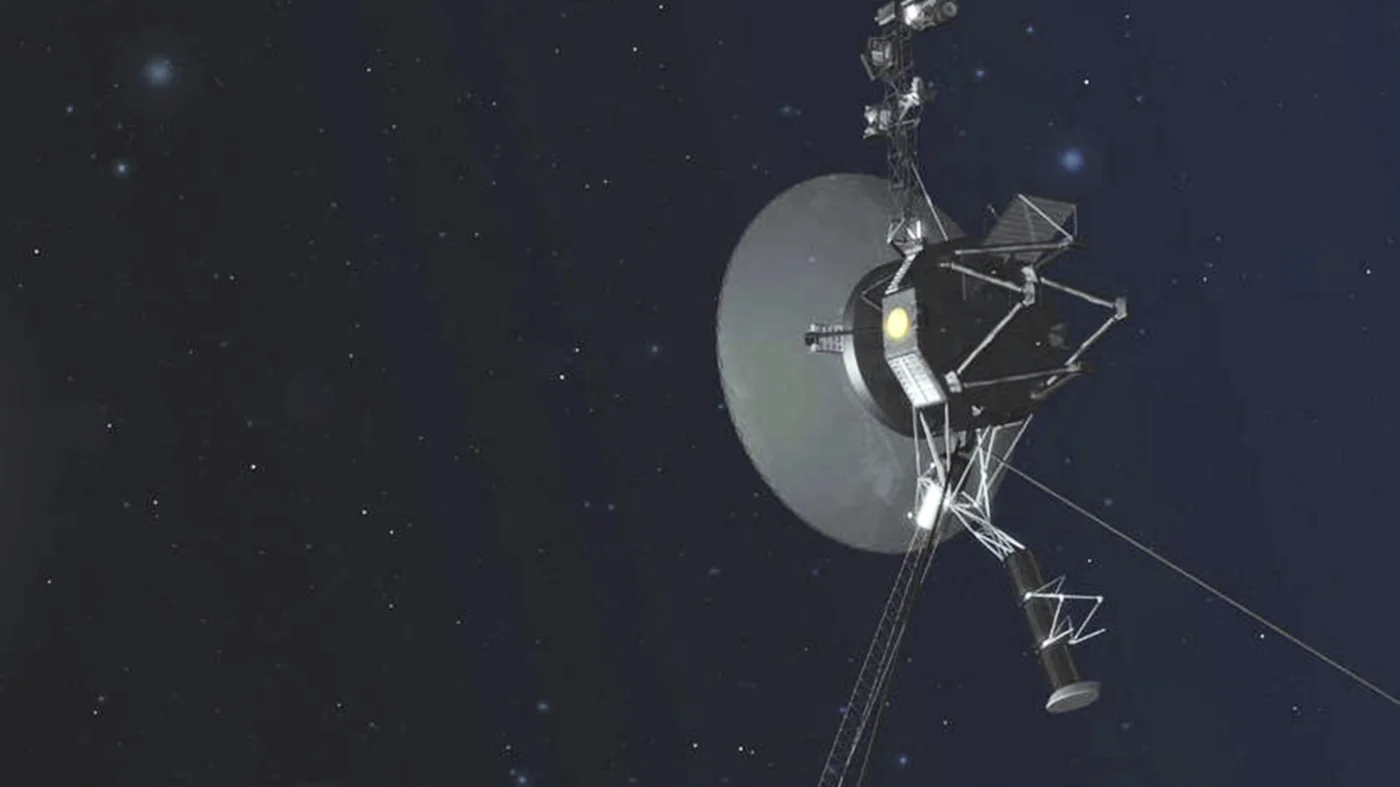
Voyager 1 is farther from Earth than any other human-made object, continuing a journey that began with its launch in 1977. NPR describes the spacecraft as both a scientific instrument and a message about the scale of the solar system. Its distance is not a simple finish line: the probe keeps moving while its ability to communicate slowly weakens.
The spacecraft outlived its original plan
Voyager 1 was designed for a planetary mission, including close observations of Jupiter and Saturn. Engineers then used its trajectory to send it outward, and decades of careful operation extended the mission far beyond its initial expectation. The craft’s survival reflects redundancy, conservative engineering and the discipline of turning off systems as power declines. Reporting context: NPR
Power is now the central constraint
The probe’s radioisotope power source produces less electricity each year. Mission controllers have had to choose which heaters and instruments can remain on, balancing scientific return against the energy required to keep hardware within operating limits. A distant spacecraft cannot be repaired physically, so teams diagnose problems through weak signals and commands that take many hours to travel between Earth and the probe.
Its data describes a changing environment
Voyager 1’s importance is not only that it is far away. Instruments have measured particles and magnetic fields in the outer heliosphere, helping researchers understand the boundary where the Sun’s influence meets interstellar space. The observations are sparse compared with a modern satellite’s data stream, but they sample a region no nearby Earth-orbiting instrument can reproduce. Reporting context: NPR
Communication is a test of patience
At this distance, a command and its reply cannot be treated like a normal software update. Controllers send instructions, wait for the signal, inspect the result and plan the next intervention. Small faults can require months of careful work. The mission therefore demonstrates an operational lesson as much as a scientific one: reliability often comes from slow decisions and graceful degradation rather than constant upgrades.
A long afterlife for a human project
Voyager carries a record intended to represent life and culture on Earth, but its more lasting contribution may be practical knowledge about operating machines beyond the expected mission. Its eventual silence will not erase that record. Every additional measurement extends a scientific baseline and gives future designers evidence about how materials, power systems and control software behave over an extraordinary span of time. The spacecraft is also a reminder that exploration is cumulative: a probe built for one planetary alignment can become a tool for studying the edge of the solar system when engineers keep adapting the mission.
Sources and editorial notes
This article compiles the linked reporting. Allegations, projections and research findings retain their original qualifications; this page does not represent independent field reporting or expert medical review.
- NPR (reporting)
- NASA: Voyager’s light-day milestone (primary)
November 17, 2026: Replaced repeated summary and FAQ templates, added source attribution and image description, and clarified the distinction between source publication and site edits. This editorial update is not an independent fact-check certification.