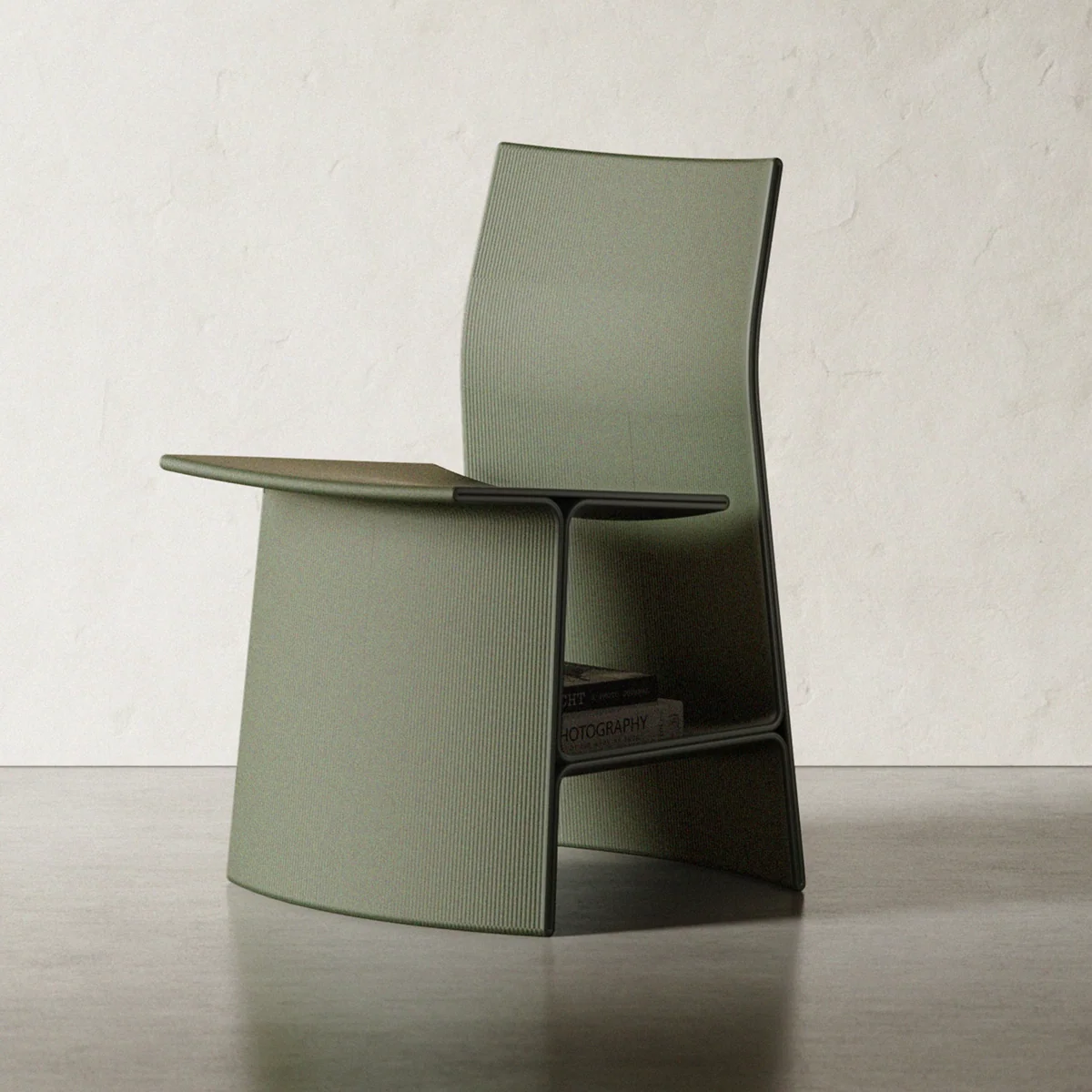
Barcelona designer Pablo Castillo has developed Kino for American furniture company Decibel. The chair combines a curved backrest, two legs, a cantilevered seat and a shelf beneath the seat in a single printed component, giving books a place within the furniture's structure. Dezeen
Key facts
Kino's monobloc structure combines two legs, a curved backrest, the under-seat shelf and a T-shaped seat. Dezeen
According to the project account, those fibres increase strength and help make the cantilevered geometry possible. Dezeen
The design therefore uses thickness and geometry together rather than assuming a solid printed object must feel entirely inflexible. Dezeen
Kino builds storage into a printed chair
Barcelona-based designer Pablo Castillo has developed Kino, a 3D-printed chair with a shelf beneath its cantilevered seat. Created for American furniture company Decibel, the design is shortlisted for seating design of the year in the Dezeen Awards. Dezeen describes a project that starts with a recognisable chair silhouette but allows the manufacturing process to influence its form. Storage, support and seating are brought together in a single printed component instead of treated as unrelated additions.
One component carries several functions
Kino's monobloc structure combines two legs, a curved backrest, the under-seat shelf and a T-shaped seat. The seat projects both forwards and backwards, creating the cantilevered arrangement. This integration gives the lower part of the chair a practical role beyond supporting the user: books or other objects can sit in the space below. It also makes the relationship between the seat and its support visually clear, because the same continuous form produces both the furniture's outline and its internal storage area.
Material reinforcement enables the projection
The indoor version is printed from PLA reinforced with cellulose plant fibres. According to the project account, those fibres increase strength and help make the cantilevered geometry possible. Decibel also offers an outdoor version made from recycled PETG, a different thermoplastic polyester. The distinction matters because the report is describing two material options for different uses, not one universally interchangeable specification. It does not provide a comparative lifecycle assessment, certified load rating or evidence that either material can be disposed of through an ordinary household waste stream.
A corrugated underside introduces movement
Castillo incorporated a corrugated structure into the lower part of the seat. He says this reinforcement gives the chair more movement than a typical rigid 3D-printed seat and accommodates both reclined and forward-leaning postures. The design therefore uses thickness and geometry together rather than assuming a solid printed object must feel entirely inflexible. These are the designer's descriptions of intended performance; the article does not report an independent ergonomic trial comparing comfort across a measured group of users. Reporting context: Dezeen
Printing becomes a source of character
The designer wanted the layer-by-layer process and substantial material thickness to generate features, including the T-junctions, cantilevers and storage. Decibel uses a Caracol robotic 3D printer, which it says permits forms not achievable through injection moulding. The chair's appearance can consequently be read as an expression of how it is made, rather than an imitation of a conventional moulded plastic chair. Its geometry is linked to the production method as well as to the basic dimensions of a seat. Reporting context: Dezeen
Part of a broader furniture collection
Kino joins Decibel's Editions collection alongside designs by Charles Birshaw, Karim Rashid and Deniz Aktay. The New Jersey company introduced the collection at Alcova in Milan in 2025, printing chairs live inside the former SNIA factory in Varedo. That context places Kino within an ongoing effort to make robotic printing a furniture-production method, not simply a tool for display prototypes. The finished design's most distinctive contribution is the way one continuous component combines support, limited flexibility and a useful storage space. Reporting context: Dezeen
Sources and editorial notes
This article compiles the linked reporting. Allegations, projections and research findings retain their original qualifications; this page does not represent independent field reporting or expert medical review.
- Dezeen (reporting)
November 17, 2026: Replaced repeated summary and FAQ templates, added source attribution and image description, and clarified the distinction between source publication and site edits. This editorial update is not an independent fact-check certification.