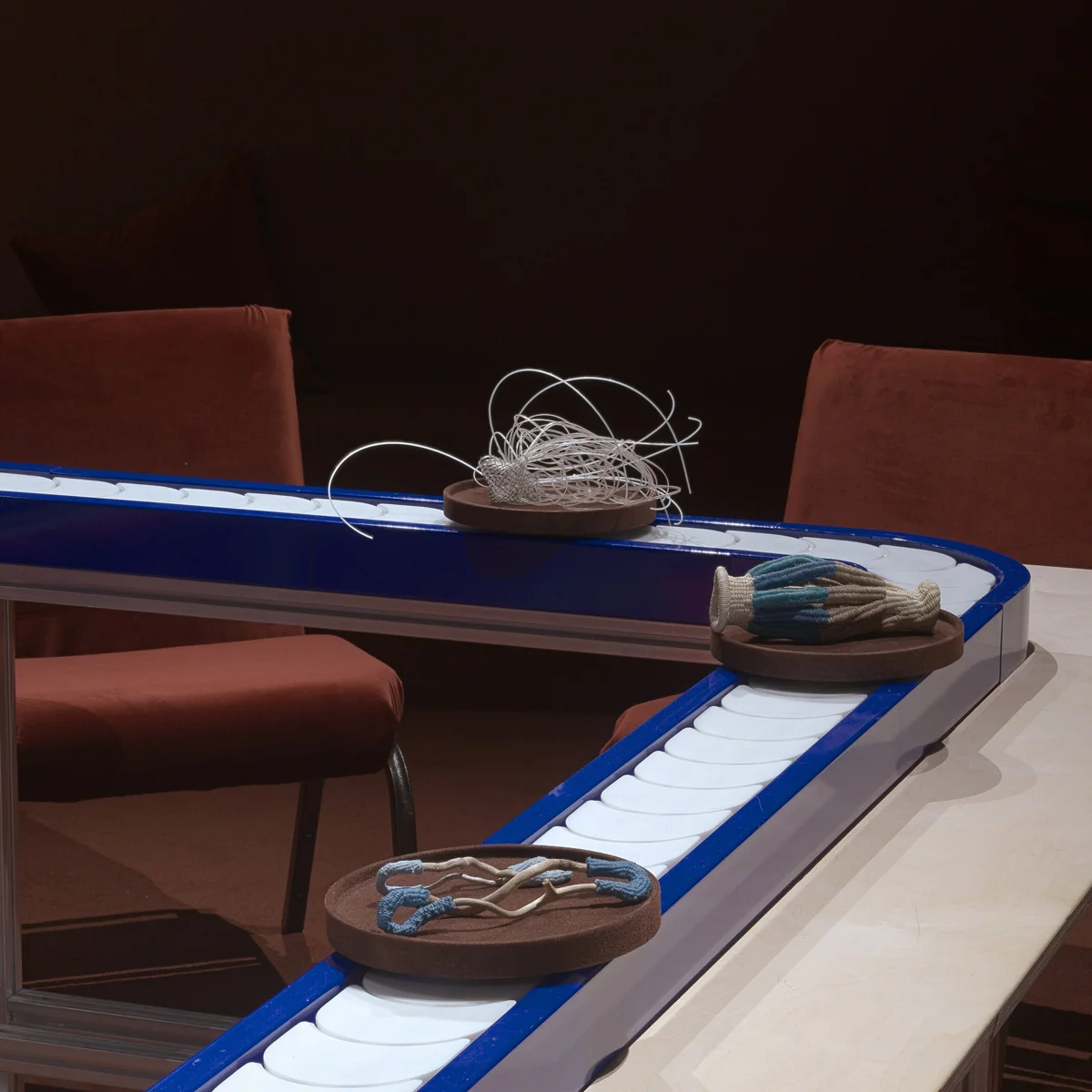
Artist Finnegan Shannon has installed a 12-foot conveyor belt at Pioneer Works in Brooklyn. There’s No Me Without You moves artworks and objects past seated visitors, adapting a display system more commonly associated with restaurants to make an exhibition easier to experience while resting. Dezeen
Key facts
The conveyor is based on a retail and restaurant display system similar to those used for sushi. Dezeen
Brightly coloured air filters sit within the conveyor loop, while visitors are encouraged to wear masks. Dezeen
The installation hosts new commissions by Joselia Rebekah Hughes, Ariana Martinez and Alex Dolores Salerno across three consecutive exhibitions. Dezeen
An exhibition brings artworks to seated visitors
Artist Finnegan Shannon has installed a conveyor system at Pioneer Works in Brooklyn so visitors can experience art while seated. The project, There's No Me Without You, arranges chairs around a closed-loop mechanism approximately 12 feet long. Dezeen reports that artworks, archival material and portable DVD players travel on moving trays. Instead of requiring a visitor to stand and move from object to object, the installation changes the relationship between the exhibition and the person viewing it.
A restaurant mechanism serves a different purpose
The conveyor is based on a retail and restaurant display system similar to those used for sushi. Shannon, who has cerebral palsy, describes it as a way to experience art with less pain. The borrowed technology becomes a practical accessibility tool rather than merely an unusual visual effect. By allowing objects to arrive within a seated viewing arrangement, it questions the assumption that a conventional gallery visitor should be able to remain upright for long periods while following a fixed exhibition route.
Comfort is built into the room
Rich fabrics cover the surrounding space, and benches run around its perimeter. Those features extend the invitation to rest beyond the chairs immediately facing the belt. Brightly coloured air filters sit within the conveyor loop, while visitors are encouraged to wear masks. The room therefore treats access as involving several conditions at once: posture, fatigue, the way objects are encountered and the shared air. It does not present a single device as a complete answer to every visitor's needs.
Other disabled artists shape the programme
The installation hosts new commissions by Joselia Rebekah Hughes, Ariana Martinez and Alex Dolores Salerno across three consecutive exhibitions. Visitors are invited to engage through touch, sight and sound. Shannon's infrastructure thus becomes a setting for other artists' work rather than the sole object of attention. That decision connects the form of the exhibition with its title: different contributions depend on a common support system, and the possibilities for encountering each work are shaped by how the room is organised.
Interdependence extends beyond the artist's name
Shannon emphasises that exhibitions rely on art handlers, facilities workers, curators, registrars, accountants and assistants. Their account extends further to paid and unpaid care, friends, family and wider networks of labour. This makes access part of a broader understanding of artistic production. The installation asks viewers to notice not just the creator credited on a label but the people and arrangements that allow the experience to exist. Its practical seating and moving displays make that argument visible through use.
A continuation of access-focused work
Shannon's earlier projects include Alt Text as Poetry with Bojana Coklyat, which explores image description, and Do You Want Us Here or Not, a series of benches and cushions encouraging museum visitors to rest. The Pioneer Works exhibition continues that attention to the conditions of participation. It runs from 12 September to 20 December. Its contribution is a working proposal for how exhibition space can adapt around disabled experience, while pointing visitors toward a larger disability culture rather than treating access as a personal exception. Reporting context: Dezeen
Sources and editorial notes
This article compiles the linked reporting. Allegations, projections and research findings retain their original qualifications; this page does not represent independent field reporting or expert medical review.
- Dezeen (reporting)
November 17, 2026: Replaced repeated summary and FAQ templates, added source attribution and image description, and clarified the distinction between source publication and site edits. This editorial update is not an independent fact-check certification.