November 27 coverage revisits research published on June 16, 2026, identifying andradite garnet in a tiny clast within the Martian meteorite NWA 8171. Multiple laboratory methods support the mineral identification, but its formation history remains uncertain. Researchers consider unusual igneous or alteration processes and cannot exclude material delivered to Mars by an impactor. The work does not establish life, a gemstone deposit or a new November discovery.
Key facts
The journal paper is DOI 10.7185/geochemlet.2619, in Geochemical Perspectives Letters volume 40.
The examined clast measures approximately 540 by 830 micrometres.
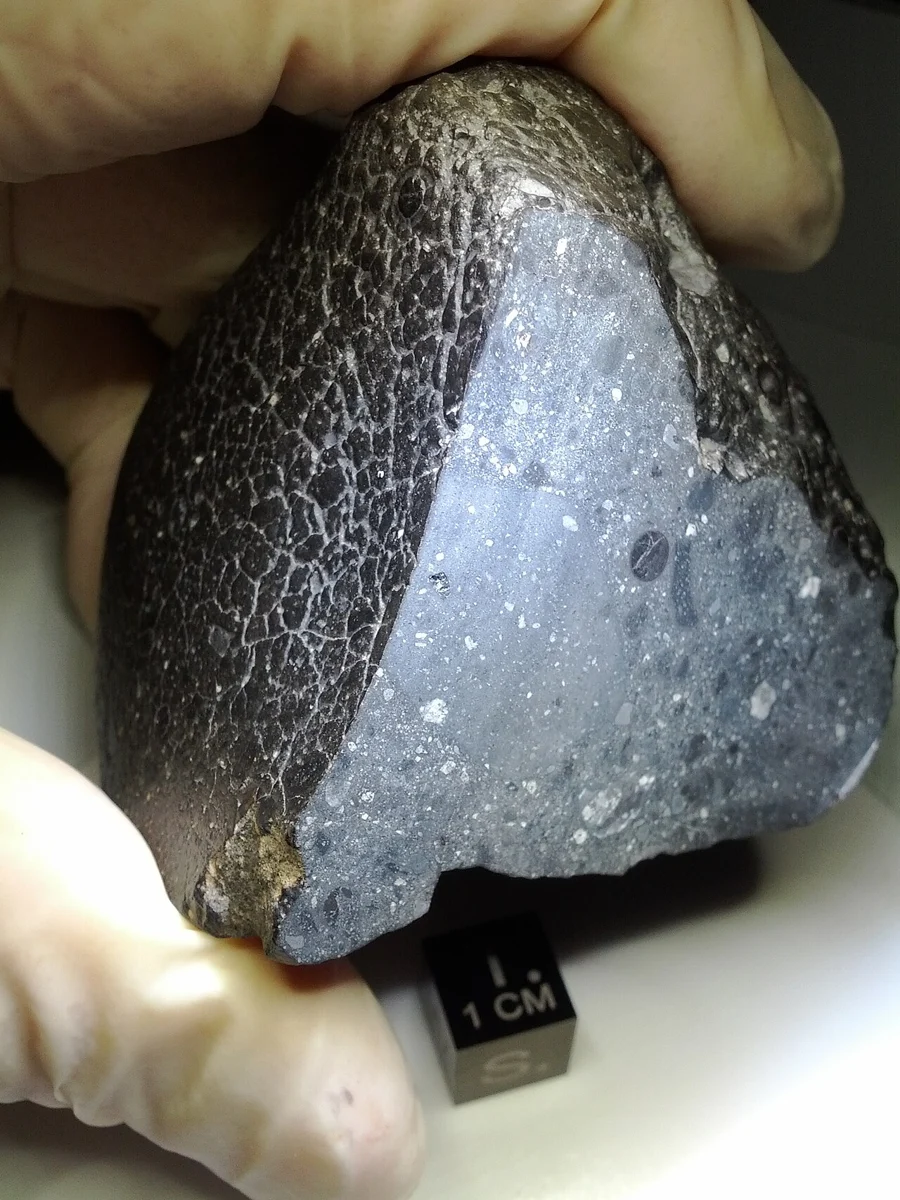
NWA 8171 belongs to the paired breccia group associated with NWA 7034, Black Beauty.
The authors propose further isotope work; this article does not report those future measurements as completed.
The news date and the research date are different
The garnet finding comes from a June 2026 paper revisited in November coverage, not a newly published November experiment. ScienceAlert’s November 27 article discusses results already published on June 16 in Geochemical Perspectives Letters. The University of Portsmouth’s announcement followed on June 17. Keeping those dates separate gives readers an accurate timeline while allowing a useful explanation of the renewed attention.
The sample is NWA 8171, a meteorite in the Royal Ontario Museum’s collection. Researchers found an andradite-bearing fragment within it; andradite is an iron-rich member of the garnet mineral group. Garnet does not have to resemble the familiar red jewellery stone, so visual expectations alone can be misleading. The finding is scientifically interesting because a previously unrecognised mineral assemblage can reveal processes missing from a simplified picture of Martian rocks. Its importance does not require presenting the research as newer than it is, or turning a small identified component into a large deposit.
A sub-millimetre fragment carries several kinds of evidence
The analysed fragment is less than one millimetre across, so the study concerns a very small piece of a complicated rock. The paper describes a clast about 540 by 830 micrometres, equivalent to roughly 0.54 by 0.83 millimetres. A clast is a fragment enclosed in another rock; a breccia is a rock assembled from fragments. Those definitions matter because material enclosed in a Martian meteorite need not all share the same formation history.
NWA 8171 belongs to a paired breccia group that includes NWA 7034, widely called Black Beauty. A photograph of that better-known related meteorite illustrates the group, not the exact grain studied here. The paper distinguishes two mineral domains within the clast, including andradite with diopside and another assemblage involving potassium feldspar and augite. Their relationships provide clues to more than one stage of formation or alteration. Compared with treating the meteorite as one uniform sample, following these small-scale differences allows a more careful reconstruction of its history.
The identification relies on structure as well as chemistry
Several laboratory techniques support the identification of andradite rather than a visual guess. Researchers used chemical analysis, Raman spectroscopy and electron backscatter diffraction. Raman measurements examine how light interacts with a material’s molecular or crystal vibrations. Electron backscatter diffraction provides information about crystal structure and orientation. Their agreement strengthens identification because similar-looking minerals can differ in composition and atomic arrangement.
Chemical maps also show how the minerals sit beside one another. The paper discusses irregular contacts, intergrowths and variations between the clast’s domains, which are evidence for its subsequent interpretation rather than decoration around a striking photograph. The University of Portsmouth release explains how an initially unusual chemical signal prompted a closer examination. That is a useful account of why the mineral was investigated, but the resulting evidence is in the analyses, not the surprise alone. Readers can distinguish two levels of confidence: the methods support what mineral is present, while a much broader argument is needed to explain exactly where, when and through which sequence of processes it formed.
Several formation routes remain under consideration
The authors consider multiple geological pathways rather than one proven origin for the garnet-bearing material. The paper discusses unusual alkali-rich igneous processes and transformation by heat, pressure or chemically active fluids. Metamorphism refers to changes to existing rock under altered physical conditions; metasomatism involves chemical change through material exchanged with fluids. Impact events could also disturb or transform earlier material, complicating the order in which textures formed.
Some temperature estimates apply to particular minerals or domains, not to the entire planet or its atmosphere. The potassium-feldspar discussion includes values around 900–1,000°C, while other parts of the assemblage imply different constraints. These are tools for assessing possible histories, not a direct weather record for ancient Mars. Likewise, evidence compatible with alteration does not by itself establish a habitable environment. The study’s value is in expanding the set of processes worth investigating and setting tests for competing explanations. A scientifically useful new rock type can raise better questions without yet supplying a single, complete answer.
A Martian host does not settle every ingredient’s origin
The possibility of material delivered from somewhere beyond Mars remains open, even though the host meteorite is classified as Martian. The paper compares manganese-to-iron patterns and other mineral chemistry with planetary and meteorite materials. Some measurements are consistent with Mars; others overlap a wider range of possible sources. In a fragment-rich breccia, an ancient impactor’s material could in principle have become incorporated before the rock later reached Earth.
That is a competing hypothesis, not a demonstration that the garnet definitely came from another body. It explains why describing the finding simply as proof that garnet formed on Mars goes further than the authors’ evidence. Different claims need different tests: identifying the mineral, identifying the host rock and locating the mineral’s original formation environment are related but separate tasks. Our wider science coverage follows that distinction because laboratory discoveries often establish one layer firmly while leaving the next open. The uncertainty is part of the result, not a reason to replace it with a more dramatic certainty.
What further isotope work could clarify
Further isotope measurements could test the fragment’s provenance more directly, but the proposed work should not be reported as an already completed result. Isotopes are forms of an element with different neutron counts. Comparing their proportions can help investigators assess relationships between materials whose visible minerals or bulk chemistry are not uniquely diagnostic. The researchers identify oxygen-isotope work as a possible next step toward narrowing the origin question.
The sample’s scarcity creates a practical trade-off because some future measurements would consume material. The choice is therefore between obtaining additional evidence and preserving a rare fragment for other analyses. Neither the university announcement nor the November report establishes that this next stage has already resolved the debate. Readers should look for a subsequent paper with actual measurements before concluding that a specific origin has been proved. For now, the reliable takeaway is narrow but significant: garnet-bearing material has been identified in a Martian breccia, and its mineral relationships open several testable explanations. It is not evidence of life, a mapped Martian gemstone resource or a rover discovery made this month.
Frequently asked questions
Is the pictured Black Beauty specimen the grain analysed in the paper?
No. The illustrative NASA photograph shows NWA 7034, a related member of the paired meteorite group. The study examined a clast in NWA 8171. Its laboratory figures, rather than the archival hero image, document that fragment. Research paper.
Sources and editorial notes
This briefing synthesises the linked primary and reporting sources below. Allegations, forecasts and early research retain their stated scope and qualifications.
- ScienceAlert (reporting)
- University of Portsmouth (primary)
- Geochemical Perspectives Letters: Kizovski et al. (primary)
November 27, 2026: Original English synthesis of the linked sources, guided by reader questions recorded before drafting. Source dates are preserved separately. This is attributed desk compilation, not original interviews, field reporting or credentialed specialist review.