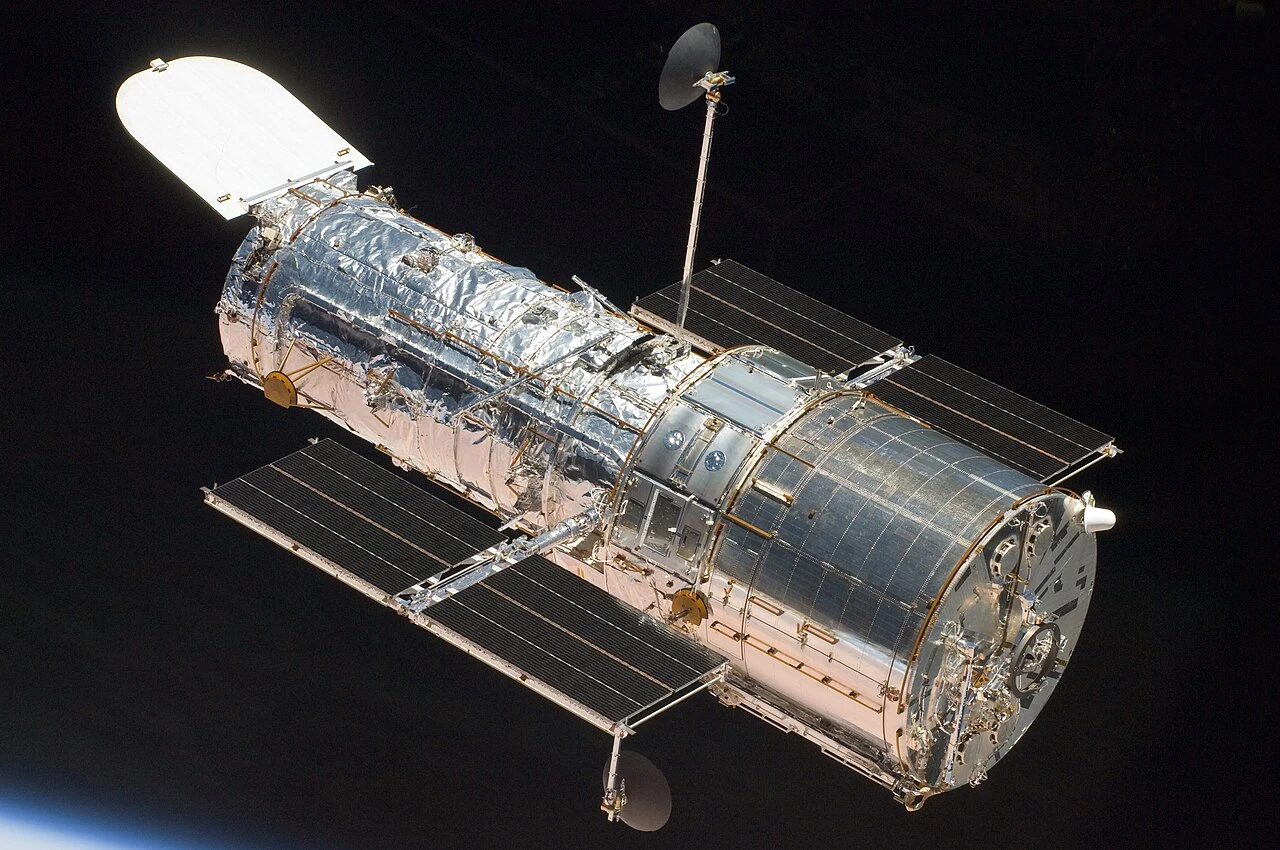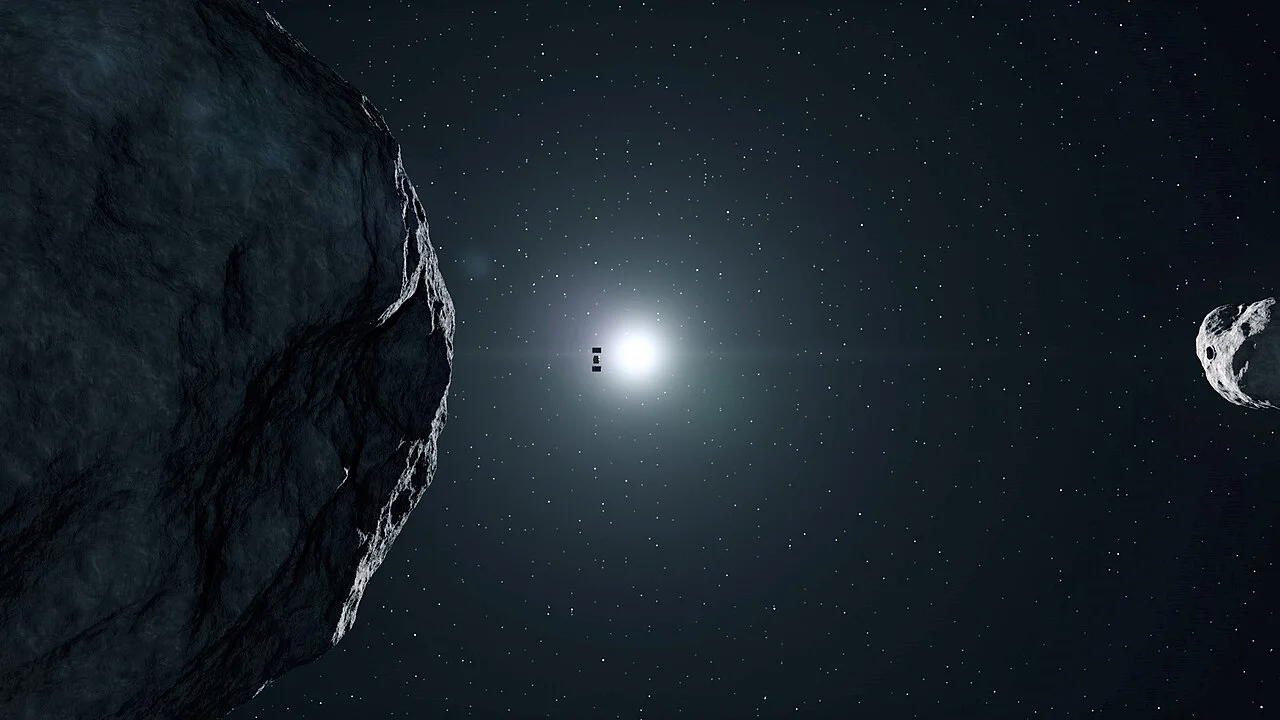
First close-up images from the European Space Agency’s Hera spacecraft show that NASA’s 2022 DART impact flattened one side of asteroid moonlet Dimorphos into a stadium-sized crater spanning its full width and sent it tumbling chaotically around Didymos, while untouched boulder fields stayed largely intact. Hera also detected hundreds of metre-scale orbiting boulders and will close to 13 km in December 2026 before deploying two CubeSats in January 2027 to measure Dimorphos’s mass and interior.
Key facts
Dimorphos (151 m wide) orbits Didymos (730 m wide) roughly 193.5 million km from Earth; NASA’s September 26, 2022 DART impact shortened its orbit by 33 minutes.
Hera is currently flying rectangular orbits 25–30 km from the binary system at an average speed of 12 cm/s using its Asteroid Framing Camera, 25-colour Hyperscout H imager and JAXA’s Thermal Infrared Imager.
In January 2027, Hera plans to deploy two CubeSats: Luxembourg-led Juventas (carrying a low-frequency subsurface radar) and Italy-led Milani (studying surface minerals and dust).
ESA and JAXA are applying lessons from Hera to the follow-on Ramses mission for asteroid Apophis’s safe 32,000 km Earth flyby on April 13, 2029.
Three competing predictions—and an outcome combining all of them
First close-up imagery from the European Space Agency (ESA) Hera spacecraft reveals that NASA’s 2022 Double Asteroid Redirection Test (DART) flattened one side of asteroid moonlet Dimorphos into a sports-stadium-sized crater while leaving other boulder fields largely untouched. Unveiled on November 25, 2026 inside the dinosaur hall of Berlin’s Museum für Naturkunde, the observations answer a four-year scientific question left open after Earth telescopes showed that DART’s September 26, 2022 collision had shortened Dimorphos’s orbit around Didymos by 33 minutes—a far larger shift than planners initially predicted.
Dimorphos is a 151-metre moonlet orbiting the 730-metre parent asteroid Didymos roughly 193.5 million kilometres from Earth. Before Hera arrived, planetary scientists debated three rival expectations: that DART had carved a conventional impact crater, that it had deformed the loosely bound rubble pile globally, or that the surface had barely changed. Hera principal investigator Patrick Michel of CNRS and the Observatoire de la Côte d’Azur reported that all three occurred at once: the struck hemisphere collapsed into a crater spanning the moonlet’s entire width, yet boulder fields across untouched regions still closely match DART’s final 2022 frames.
A wild tumble and a swarm of newly spotted orbiting boulders
Beyond reshaping the surface, the DART impact knocked Dimorphos into a chaotic tumble and left hundreds of newly discovered metre-scale boulders orbiting the binary pair. ESA Hera mission scientist Michael Kueppers confirmed that the moonlet is now tumbling wildly in its orbit around Didymos rather than keeping a steady orientation, while long-exposure multispectral images revealed a debris cloud invisible to ground telescopes.
That free-floating debris creates an immediate navigation constraint as well as a scientific clue. As Space.com also noted in coverage of the Berlin unveiling, flight engineers must track those boulders carefully before descending closer to the pair. During its early characterisation phase, the small-car-sized spacecraft is using its thrusters to hold rectangular orbits 25 to 30 kilometres away, moving through ultra-low gravity at an average speed of 12 centimetres per second while scanning the rocks with its monochrome Asteroid Framing Camera, the 25-colour Hyperscout H imager and the Thermal Infrared Imager contributed by the Japan Aerospace Exploration Agency (JAXA).
Why measuring mass and interior structure still matters for Earth defence
Turning a single deflection demonstration into a dependable planetary-defence tool still requires pinning down Dimorphos’s exact mass and interior structure—measurements scheduled for December 2026 and January 2027. Kinetic deflection refers to altering a hazardous asteroid’s trajectory by transferring momentum through a high-speed spacecraft collision rather than attempting to shatter the body. Without knowing Dimorphos’s mass and internal density, engineers cannot separate how much orbital push came from DART’s own momentum versus the recoil of blasted rock and dust.
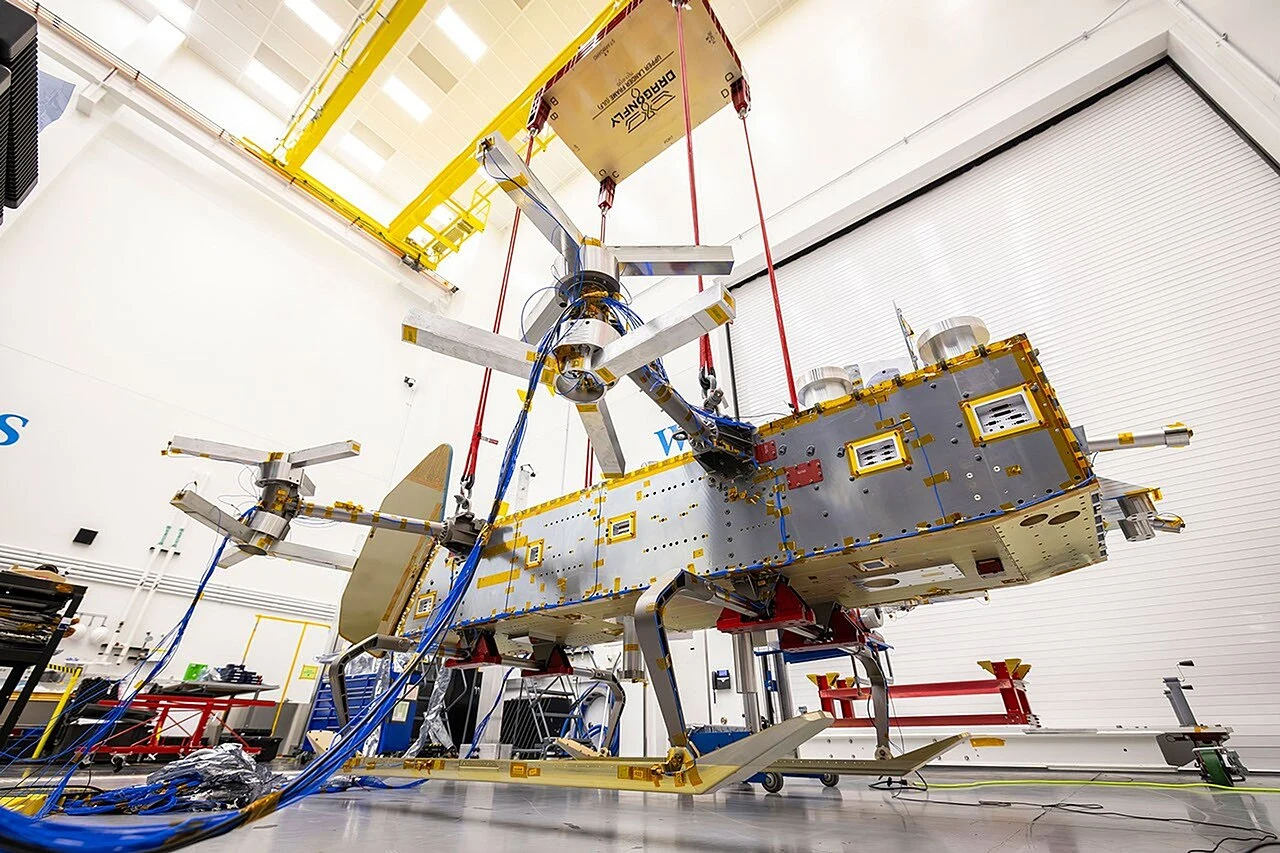
In December 2026, ESA controllers plan to fly Hera within roughly 13 kilometres of Didymos and Dimorphos for sharper mapping before deploying two shoebox-sized CubeSats—miniature modular satellites built for extreme proximity where a main orbiter faces higher risk—in January 2027. Luxembourg-led Juventas carries the smallest low-frequency radar instrument ever launched into space, designed to conduct humanity’s first subsurface radar scan inside an asteroid before attempting a touchdown to measure local gravity, while Italy-led Milani will inspect surface minerals and surrounding dust. Operating together as a coordinated three-spacecraft network around two bodies, Hera, Juventas and Milani will pin down Dimorphos’s mass—extending the wave of specialised planetary instrumentation also seen in NASA’s Dragonfly mission to Titan.
From DART and Hera to the 2029 Apophis flyby
ESA and JAXA are already applying Hera’s engineering lessons to Ramses, a follow-on planetary-defence mission targeting asteroid Apophis during its April 13, 2029 Earth flyby. Built by an 18-nation European consortium led by OHB in Germany and launched in October 2024, Hera is Europe’s first dedicated planetary-defence probe and deepens the ESA–JAXA collaboration also visible in the joint BepiColombo campaign at Mercury.
Hera mission manager Ian Carnelli and ESA Director-General Josef Aschbacher framed the Berlin reveal as a milestone linking NASA’s initial kinetic impact with Europe’s close-range forensic audit. Apophis’s 2029 pass—roughly 32,000 kilometres above Earth—is completely safe, yet close enough for terrestrial gravity to tug on its spin, surface and interior. Compared to Hera, which documents how an asteroid reacts to a deliberate impact, Ramses will observe how an asteroid responds to a planet’s natural gravitational pull, giving ESA Space Safety head Holger Krag’s programme two complementary physics benchmarks.
Frequently asked questions
Did DART shorten or lengthen Dimorphos’s orbit around Didymos?
It shortened the orbit by 33 minutes. According to the primary European Space Agency release, DART’s September 26, 2022 collision pulled Dimorphos closer and reduced its orbital period around Didymos by 33 minutes—more than models initially predicted.
Sources and editorial notes
This briefing synthesises the linked primary and reporting sources below. Allegations, forecasts and early research retain their stated scope and qualifications.
- European Space Agency: Hera reveals stadium-sized asteroid crater from spacecraft impact (reporting)
- Space.com: Hera spacecraft gets 1st up-close look at stadium-sized hole punched in asteroid by NASA DART mission (reporting)
November 26, 2026: Original English synthesis of the European Space Agency primary release and Space.com report linked here, with reader questions selected before drafting. Where secondary wording diverged on orbital direction, this explainer follows ESA’s primary release. No original interviews or independent analysis are claimed.