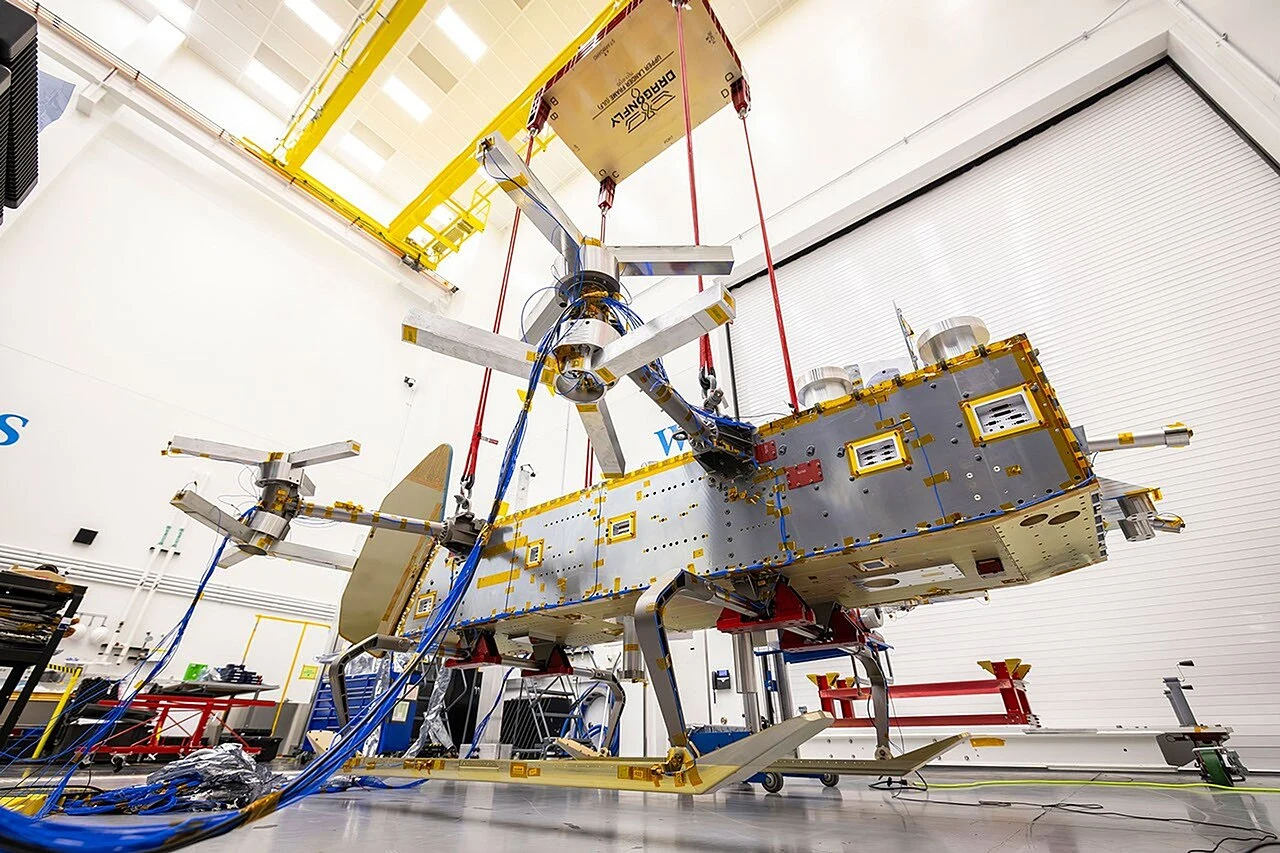
NASA says all seven DragonCam science cameras were installed, tested and integrated into the Dragonfly rotorcraft by mid-November at Johns Hopkins APL in Maryland. Two separate navigation cameras were installed earlier. The milestone is on Earth: launch is scheduled for July 2028 and arrival at Titan for late 2034. The cameras will document landscapes and sampling sites, but images or fluorescence alone would not establish the presence of life.
Key facts
DragonCam consists of seven science cameras, distinct from two navigation cameras.
The newly released views include cleanroom imagery taken on Earth in November.
A configurable LED array spans infrared to ultraviolet light for surface observations.
The schedule remains a July 2028 launch and arrival at Titan in late 2034.
What has happened in the Maryland cleanroom?
NASA Science reports that DragonCam’s seven science cameras had been placed in insulated housings, tested and integrated into Dragonfly by mid-November at Johns Hopkins Applied Physics Laboratory in Laurel, Maryland. The suite was developed and built by Malin Space Science Systems. It is an important step in assembling the rotorcraft that NASA intends to send to Saturn’s largest moon.
It is not a landing milestone. A panorama described in the announcement was taken on November 9 in the APL cleanroom shortly after installation. Its yellow tint reflects how DragonCam captures light, rather than showing the colour of a newly photographed Titan location. The hardware remains on Earth.
Why seven science cameras does not mean seven cameras in total
Dragonfly also has two navigation cameras installed earlier in the summer. Within DragonCam itself, two forward-facing cameras combine wide-angle and higher-resolution views, with overlapping images providing a stereoscopic perspective. Two additional side-facing wide-angle cameras extend the landscape coverage into panoramas.
Two downward-facing cameras look beneath the vehicle, and a microscopic imager studies the sampling location in close detail. The different perspectives are meant to connect small-scale grains and drill sites with the surrounding terrain. Counting only the science suite while forgetting the navigation pair would give an incomplete picture of the imaging hardware.
How the images will support sampling
The downward views will help the team judge whether a location is suitable for deploying the DrACO sampling tool or the seismometer. The microscopic imager is designed to resolve details in millimetre-sized sand grains around the drill location. That visual context is useful because a sample makes more scientific sense when its surrounding geology is documented.
NASA plans to collect material at multiple sites, so the cameras will help relate one sampling location to another and to the broader landscape. A camera’s role here is to provide measurements and context alongside the other instruments, rather than replace the chemical and physical investigations those instruments are intended to perform.
What lighting can reveal in Titan’s cold and darkness
The cameras look through windows in insulating enclosures designed for an environment around minus 290 degrees Fahrenheit. Titan’s night lasts nearly eight Earth days. A configurable LED array provides illumination from infrared to ultraviolet, allowing observations even when natural light is unavailable.
NASA says ultraviolet observations may identify organic molecules that fluoresce, and that colour information can support inferences about surface composition. Organic chemistry and fluorescence should not be turned into a claim of detected life. The announcement describes scientific capabilities; it reports neither observations on Titan nor a biological conclusion.
What comes next, and when could Titan images arrive?
Other instrument packages—including DraGNS, DraGMet, DraMS and DrACO—are due for delivery, integration and testing over the coming months, according to NASA Science. Those future steps show why installing the cameras is one stage in building an observatory rather than the completion of every mission test.
NASA’s stated schedule is launch in July 2028 and arrival at Titan in late 2034. These are mission targets, not a guarantee against future changes. For readers following the project now, cleanroom images and integration results are evidence of preparation; views actually taken at Titan belong to a later phase that has not yet occurred.
Frequently asked questions
Have Dragonfly’s cameras already taken pictures on Titan?
No. The cameras are integrated into the rotorcraft on Earth at Johns Hopkins APL in Maryland. The NASA announcement describes November cleanroom images, not photographs sent back from Titan.
How many science cameras does Dragonfly carry?
Seven in the DragonCam science suite. NASA Science also describes two separate navigation cameras installed earlier, so the science-camera count should not be mistaken for the total number of cameras.
When is Dragonfly scheduled to reach Titan?
Late 2034 under the schedule in the November 24 update, following a planned July 2028 launch. These are mission targets rather than an already completed journey.
Could the cameras alone establish that life exists there?
No. NASA Science says the cameras may identify fluorescence from organic molecules and provide context for other instruments. Those capabilities are not themselves proof of life, and no Titan observations are reported in this integration update.
At a glance
| Component | Role | Important distinction |
|---|---|---|
| Forward and side cameras | Stereo and panoramic terrain views | Science imaging, not all navigation hardware |
| Two downward cameras | Context beneath the rotorcraft | Supports sampling and instrument deployment |
| Microscopic imager | Details around the drill site | Part of the seven-camera science suite |
| LED array | Infrared-to-ultraviolet illumination | Possible fluorescence is not proof of life |
Sources and editorial notes
This article compiles the linked reporting. Allegations, projections and research findings retain their original qualifications; this page does not represent independent field reporting or expert medical review.
- NASA Science (reporting)
Original English synthesis compiled on November 25, 2026 from the sources listed below. Source publication times are retained separately; statements, forecasts and unresolved questions remain attributed.