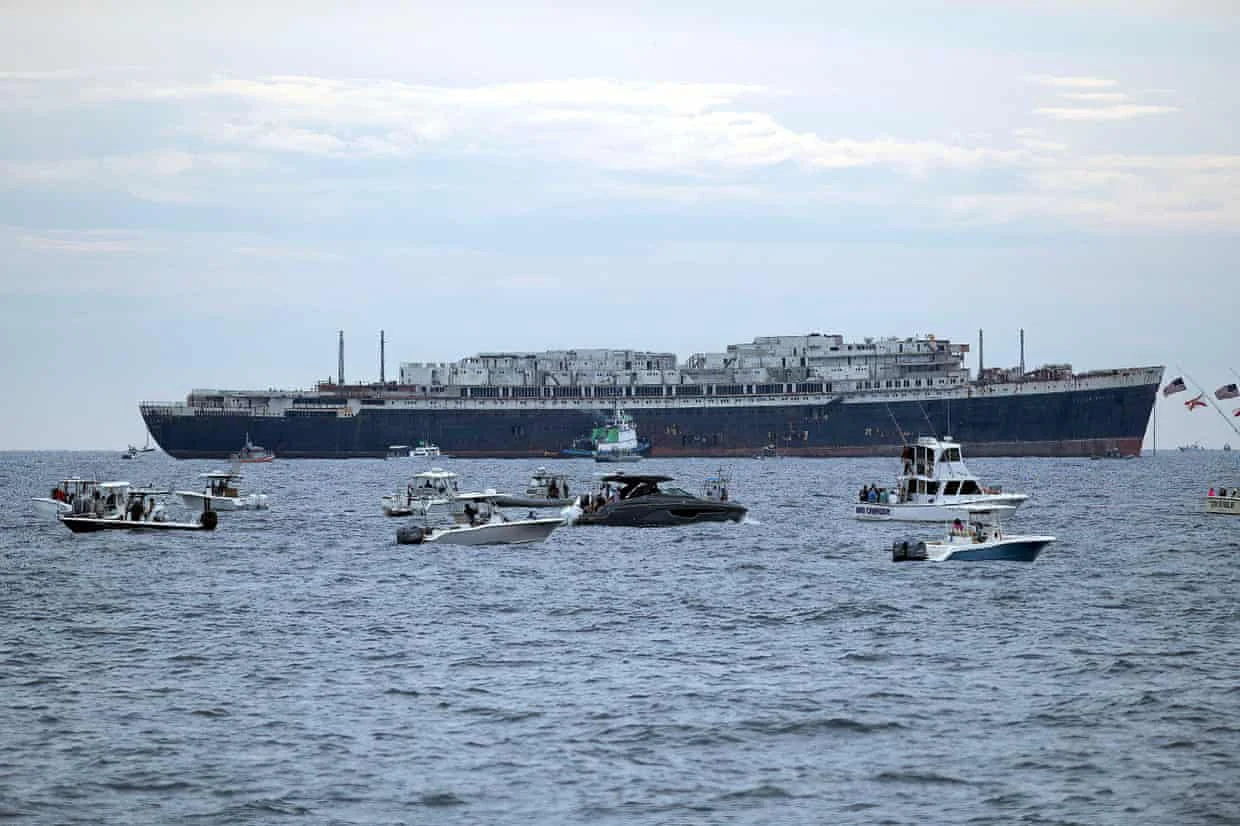
The retired ocean liner SS United States has been deliberately sunk off Destin, Florida, to create an artificial reef. The ship was prepared with openings in its hull so water could enter and allow it to settle upright. The Guardian
Key facts
Launched in 1952, the American-built liner set a transatlantic speed record on its maiden voyage. The Guardian
The ship had been hollowed out and openings cut in its hull so that water could enter and it could settle upright. The Guardian
The wreck rests at roughly 180 feet deep, while the upper decks are about 55 feet beneath the surface. The Guardian
A historic liner becomes an underwater landmark
The SS United States has been sunk off Destin, Florida, to become what organisers describe as the world's largest artificial reef. The nearly 1,000-foot ocean liner reached the seafloor on Wednesday night after a carefully prepared flooding operation, according to the Guardian.
Its new role follows years of unsuccessful efforts to preserve or redevelop the ship above water. The project combines a marine habitat proposal and diving attraction with the difficult question of how to retain the history of an enormous vessel whose upkeep had become unaffordable.
The ship once represented transatlantic speed
Launched in 1952, the American-built liner set a transatlantic speed record on its maiden voyage. It carried thousands of passengers across the Atlantic during 17 years of service before retirement in 1969. Reporting context: The Guardian
That history explains the strength of feeling around its final destination. The vessel was an engineering achievement and a symbol of an era when scheduled ocean liners connected continents, giving preservation groups a reason to seek a future beyond scrapping.
The final descent took several hours
The ship had been hollowed out and openings cut in its hull so that water could enter and it could settle upright. The deployment began at around 2:40 p.m. Eastern time, the sinking process started shortly before 5 p.m., and the ship reached the bottom at about 10 p.m. Reporting context: The Guardian
Those stages distinguish preparation and positioning from the final descent. The operation was a planned reefing project, rather than a loss at sea with passengers or crew aboard an operating liner.
Its position will shape the visitor experience
The wreck rests at roughly 180 feet deep, while the upper decks are about 55 feet beneath the surface. Different parts of the structure therefore sit at very different depths, an important feature for anyone assessing the site as a diving destination. Reporting context: The Guardian
The Guardian reports that officials expect worldwide interest. That expectation is a tourism projection; the sinking itself does not establish how many divers will visit or how the site will develop over time.
Preservation had become financially difficult
For years the liner remained docked in Philadelphia while successive owners and supporters explored ways to restore it. In 2021, daily dockage charges rose to $1,700, a cost the nonprofit SS United States Conservancy could no longer sustain. Reporting context: The Guardian
Florida's Okaloosa County purchased the ship for $1 million in 2024 with the intention of creating an artificial reef. The transaction changed the preservation strategy from finding an economically viable surface use to retaining the structure in an underwater setting. Reporting context: The Guardian
Habitat and history now share the project
Officials anticipate habitat for species including snapper, grouper and amberjack. Those are expectations about future colonisation, rather than a survey showing that the newly sunk ship already supports a mature ecosystem.
Conservancy president Susan Gibbs, whose grandfather William Francis Gibbs designed the liner, linked the reef to a planned land-based museum and visitor experience. The ship's next chapter will therefore be judged in two places: in the marine life and diving activity around the wreck, and in how effectively its story remains accessible on shore.
Sources and editorial notes
This article compiles the linked reporting. Allegations, projections and research findings retain their original qualifications; this page does not represent independent field reporting or expert medical review.
- The Guardian (reporting)
November 17, 2026: Replaced repeated summary and FAQ templates, added source attribution and image description, and clarified the distinction between source publication and site edits. This editorial update is not an independent fact-check certification.