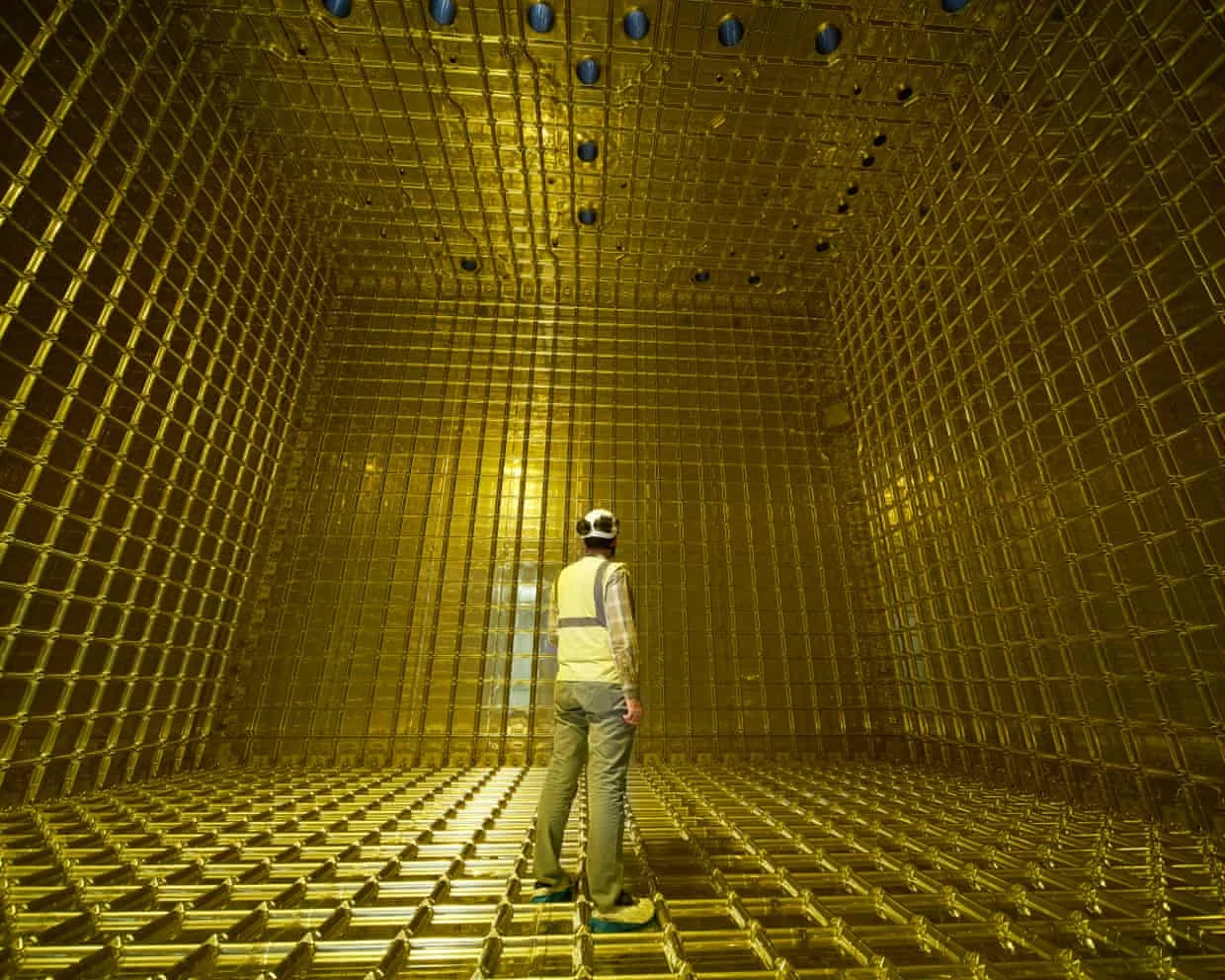
Scientists are preparing giant neutrino detectors inside the former Homestake mine in Lead, South Dakota. The Deep Underground Neutrino Experiment is being assembled roughly a mile below the Black Hills. The Guardian
Key facts
Neutrinos are electrically neutral particles produced in processes including nuclear reactions in stars, radioactive decay and accelerators. The Guardian
In the 1960s, physicist Ray Davis used a tank containing 100,000 gallons of dry-cleaning fluid in the mine to detect solar neutrinos. The Guardian
Dune's four detectors will contain a combined 70,000 tonnes of liquid argon, held at extremely low temperatures. The Guardian
A former gold mine takes on a cosmic question
The Guardian reports that engineers are beginning the assembly of giant particle detectors a mile beneath Lead, South Dakota, as the Deep Underground Neutrino Experiment moves into a new construction phase. The project, known as Dune, occupies caverns in the former Homestake gold mine at the Sanford Underground Research Facility.
Its detectors will examine neutrinos from space and from a beam sent roughly 800 miles through the Earth from Fermilab near Chicago. The objective is to measure elusive particles that may help explain why the universe contains so much more matter than antimatter. Reporting context: The Guardian
Neutrinos change as they travel
Neutrinos are electrically neutral particles produced in processes including nuclear reactions in stars, radioactive decay and accelerators. They interact so weakly that vast numbers pass through people and the planet without leaving a detectable trace.
There are three varieties, and a neutrino can change from one to another as it travels. This oscillation, together with the particles' extremely small masses, provides a route into questions that the present account of fundamental physics has not fully resolved.
The site has a long scientific history
In the 1960s, physicist Ray Davis used a tank containing 100,000 gallons of dry-cleaning fluid in the mine to detect solar neutrinos. Interactions with chlorine atoms produced argon, allowing the experiment to record particles arriving from the Sun. Reporting context: The Guardian
The mine closed in 2001 and became a dedicated underground laboratory. Its depth shields experiments from much of the activity at the surface, making the former industrial site a valuable setting for searches that depend on isolating very rare signals. Reporting context: The Guardian
Building a detector on an enormous scale
Dune's four detectors will contain a combined 70,000 tonnes of liquid argon, held at extremely low temperatures. Their structures require more than 4,000 tonnes of steel and reach up to five storeys high, according to the Guardian's report. Reporting context: The Guardian
Assembly is expected to take nearly three years, followed by about a year to fill the detectors. The work brings large-scale engineering underground, with local workers and international research groups coordinating the installation of components in confined and demanding conditions.
Turning rare collisions into measurements
Most neutrinos in the Fermilab beam will travel straight through the detector. Occasionally one will interact with an argon atom, producing light and an electrical signal. Reconstructing those events lets scientists infer properties of the incoming particle.
The UK is the largest international partner in the US-led experiment. Its contribution includes detector components, computing systems and a graphite target needed to generate the beam, linking the underground installation to equipment and analysis spread across several institutions.
Matter, antimatter and exploding stars
Dune will investigate the ordering of neutrino masses and compare the behaviour of neutrinos with antineutrinos. A difference between them could contribute to explaining how matter came to dominate after the early universe, although the experiment is not guaranteed to deliver a single complete answer.
It will also observe particles from sources such as supernovae, which carry information about extreme events that ordinary light cannot fully reveal. For Lead, that means a former source of mineral wealth is becoming infrastructure for a long programme of international scientific discovery.
Sources and editorial notes
This article compiles the linked reporting. Allegations, projections and research findings retain their original qualifications; this page does not represent independent field reporting or expert medical review.
- The Guardian (reporting)
November 17, 2026: Replaced repeated summary and FAQ templates, added source attribution and image description, and clarified the distinction between source publication and site edits. This editorial update is not an independent fact-check certification.