After Night There is Nothing uses three shelters and imagined constellations to explore how military technology changes the experience of the night sky. Dezeen’s interviews attribute the project’s interpretation to Mohamad Nahleh and Ozayr Saloojee. The built structures, their locations and the associated storytelling programme are separate parts of the work. Dezeen
What After Night There is Nothing consists of
Architect Mohamad Nahleh and architecture professor Ozayr Saloojee have created three domed structures that reimagine constellations by mapping military objects in the night sky, which were displayed at this year’s Sharjah Architecture Triennial.
Titled After Night There is Nothing, the trio of installations aim to bring attention to how communities are responding to drones, satellites, rockets and missiles changing the sky above them.
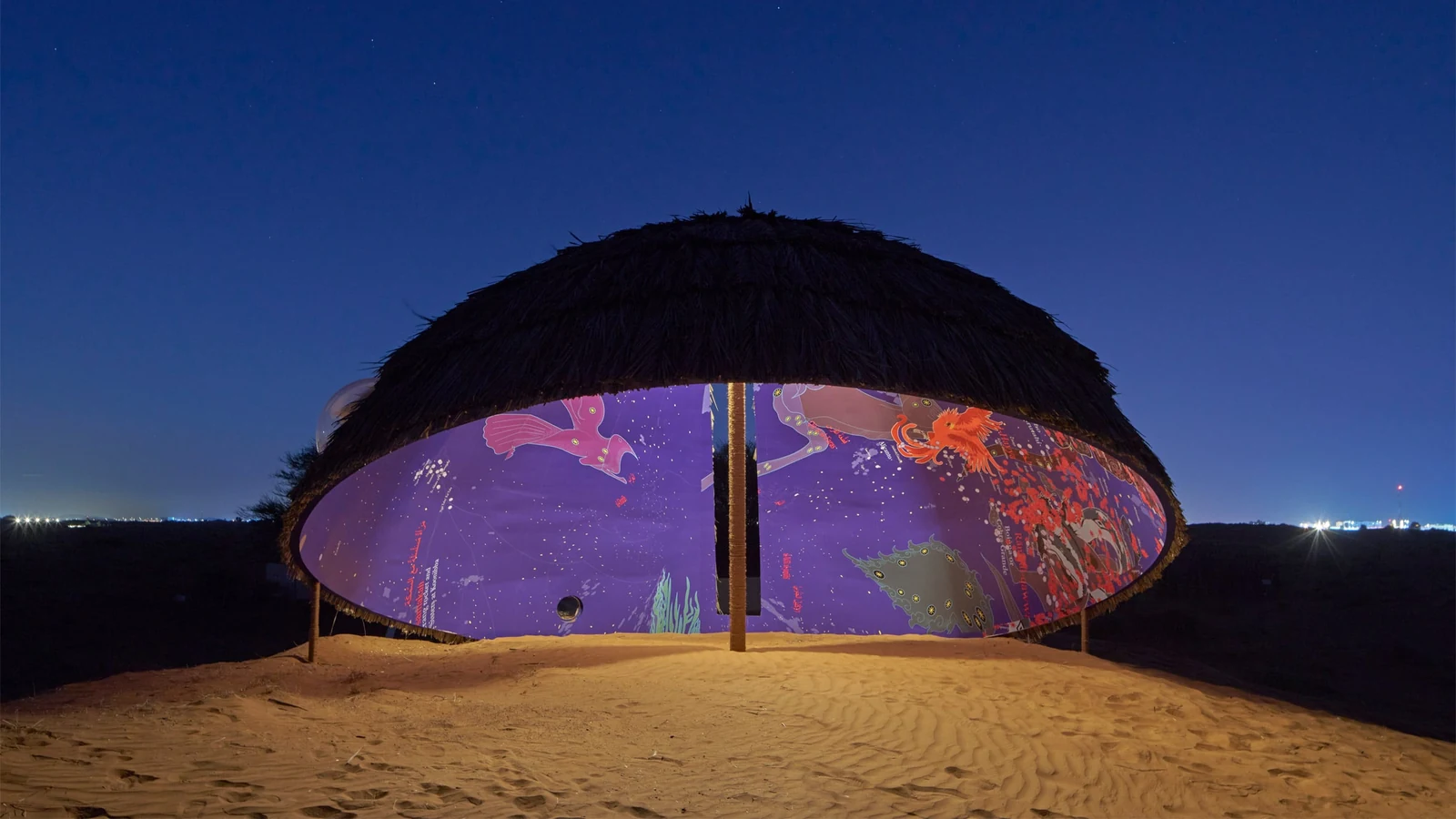
Covered in thatch, the three curved wood-and-steel structures are segments of a giant globe.
Vinyl lines the inner curves, where Nahleh and Saloojee designed creature-like constellations based on man-made military objects in the sky.
The trio of installations were displayed at three venues at the Sharjah Architecture Triennial – the Al Qasimiyah School, a former slaughterhouse, and in the sandy Al Madam town.
How the installation turns military objects into constellations
“This is ‘night sky optimism’ – optimism through catastrophe,” Nahleh told Dezeen. “The night sky we are talking about in this project is not the sky of beautiful stars and constellations, but the contemporary sky filled with drones, satellites, rockets and missiles that are changing the way we understand the sky above us.”
“The drones, missiles, rockets and satellites eclipse some of the constellations, and sometimes fuse with them,” he continued.
“That fusion is at the heart of this project – how do these technologies, through cultural practices on the ground, begin to morph into new creatures and new constellations that people try to make sense of to interpret the violence of this military technology that is taking place.”
Nahleh and Saloojee aimed to combine the reality of modern war with mythical storytelling, drawing upon their research into communities exposed to military attacks.
“We have noticed in our research that, especially in geographies witnessing prolonged violence, these objects are producing new mythical creatures – creatures that fuse together technological advancement with epistemic practices and myth-making practices that happen from the ground,” said Nahleh.
“Most of these creatures, these modern constellations as we’re calling them, are populating the night sky in our drawing alongside pathways of flights of drones, satellites and other things that manifest across the night sky we’ve inherited, rather than the one we lost,” he continued.
“We think of these creatures as ones that attempt to tame the military brightness that is populating the sky around us, be it in the shape of missiles, phosphorus, or flares.”
The shelters, openings and desert setting
As well as depicting creature-like constellations in their inner curves, the structures themselves were designed as creatures – the nocturnal Solifugi spider known to run out the sun and into shade.
“The project is dedicated to the Solifugi, which is a spider that by nature runs away from the sun, the sun of imperial savagery,” said Nahleh. “It has a very thick skin to protect it from this brightness, and in its belly is a map of the contemporary sky.”
Three openings puncture the shell in each of the installations. In the desert site at Al Madam, a vertical cut-out frames a view of the minaret of a distant mosque, and at the slaughterhouse site, a long opening was set at the height of a cow.
Storytelling and the triennial programme
Traditional Hakawati storytellers will narrate stories at the installations as part of the triennial, which runs until April.
“The story is difficult, but it’s about finding optimism,” said Nahleh. “People are carving their own histories on the weapons that are here to annihilate them.”
“There’s a paradox here that we have to confront,” he continued. “When libraries are being erased, and people have no more books to publish or things to write on, they’re writing on the weapons that are sent to devour them.”
“Kids now are finding ways again to dream by placing their wishes upon the shooting stars, which are usually missiles and rockets. It’s a sad and complicated story, but we can no longer escape it by wishing for a sky we no longer have.”
Sharjah Architecture Triennial 2026 takes place from 14 November 2026 to 14 April 2027 at various locations across Sharjah, UAE. See Dezeen Events Guide for an up-to-date list of architecture and design events taking place around the world.
Frequently asked questions
What do the domes in After Night There is Nothing represent?
The three structures use imagined constellations of drones, missiles, satellites and rockets to explore how military technology changes people's experience of the night sky. They are an architectural interpretation, not an astronomical map. Dezeen
Who created After Night There is Nothing?
Architect Mohamad Nahleh and architecture professor Ozayr Saloojee developed the project for the Sharjah Architecture Triennial. Their interviews explain the ideas behind the shelters and associated storytelling. Dezeen
Sources and editorial notes
This article compiles the linked reporting. Allegations, projections and research findings retain their original qualifications; this page does not represent independent field reporting or expert medical review.
- Dezeen (reporting)
November 23, 2026: Corrected section boundaries, removed extraction debris and repeated summary text where present, and clarified source attribution or image descriptions. This is an editorial repair of the cited reporting, not independent reporting, product testing or specialist fact-check certification. November 23, 2026: Added source-linked reader questions and answers based on the reporting already compiled in this article. These questions are editorial selections, not measured search queries.