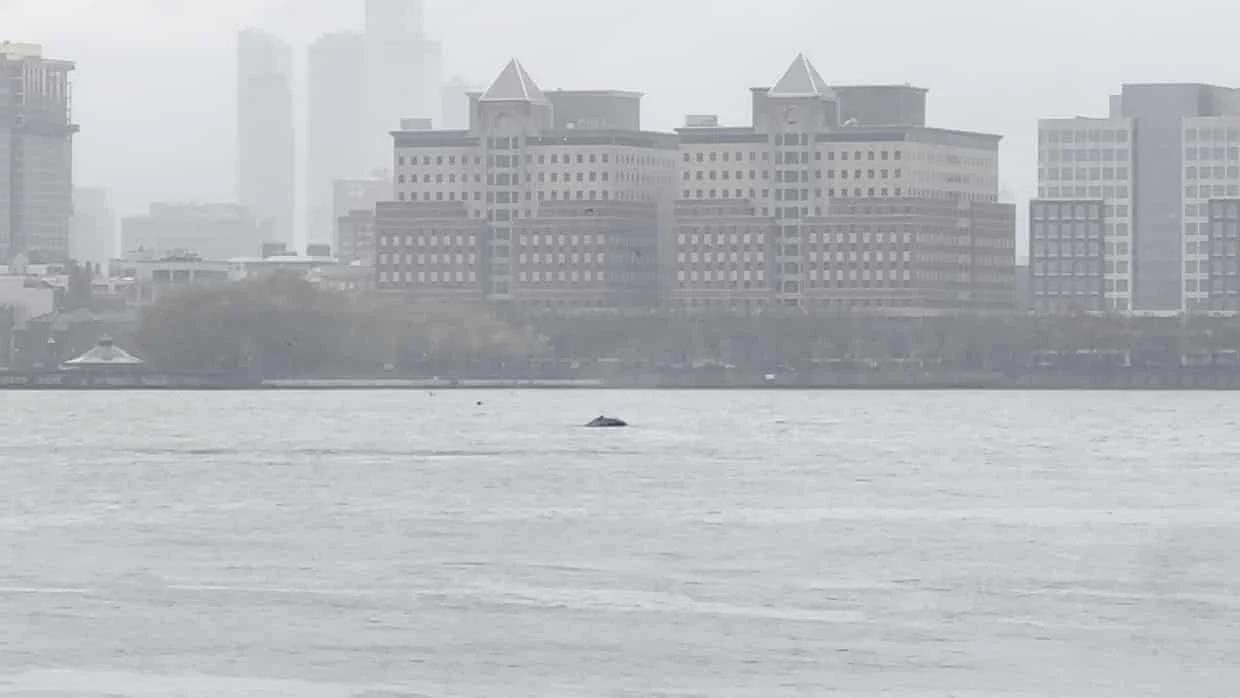
Humpback whale spotted in New York’s Hudson River on 12 November. Photograph: Ant Taboada
A humpback whale was photographed swimming in New York's Hudson River on Thursday. Images circulated widely after Manhattan borough president Brad Hoylman-Sigal and marine-mammal group Gotham Whale shared the sighting. The Guardian
Key facts
The animal's sex, size and origin had not been confirmed, and observers did not know whether it was alone. The Guardian
NOAA Fisheries explains that the shape, markings and scars on humpback tail flukes can identify individuals much like fingerprints. The Guardian
NOAA says many have increased since protections and the commercial whaling moratorium, but recovery is uneven and several populations remain endangered or threatened. The Guardian
A humpback brings attention to the Hudson
A humpback whale was seen swimming in New York's Hudson River on Thursday, drawing crowds and a rapid exchange of photographs online. Manhattan borough president Brad Hoylman-Sigal shared an image supplied by Gotham Whale, the citizen-science organisation that tracks marine mammals around the city.
Gotham Whale also released a video showing the animal rolling and blowing at the surface. The Guardian reported that it remained in the river into the early afternoon, while researchers sought more observations to establish which whale it was.
Several basic details remain unknown
The animal's sex, size and origin had not been confirmed, and observers did not know whether it was alone. A sighting at the surface cannot answer all of those questions, even when it produces striking photographs.
Gotham Whale asked people for further images and information. A clear record of where and when an animal was observed can help researchers connect sightings instead of counting every social media post as a different whale.
Photographs can function as identification
NOAA Fisheries explains that the shape, markings and scars on humpback tail flukes can identify individuals much like fingerprints. Researchers can compare photographs with a catalogue and use repeated matches to trace movements over time.
That work is more informative than simply confirming that the species entered a river. It can connect the animal with earlier records and help establish whether the same individual returns to the region.
A recovering species still faces pressure
Humpback populations were severely reduced by commercial whaling. NOAA says many have increased since protections and the commercial whaling moratorium, but recovery is uneven and several populations remain endangered or threatened.
The Guardian reported that sightings around New York have become more common, citing 272 whales observed in the city's waters in 2018. More frequent sightings create opportunities for research and public interest, while also putting animals into closer contact with heavily used coastal routes. Reporting context: The Guardian
Busy waterways create specific hazards
NOAA identifies vessel strikes, entanglement in fishing gear, underwater noise and disturbance from boats among the major threats. Collision risk is particularly high in coastal waters with heavy traffic.
An animal that surfaces near an urban shoreline may therefore be in a place where navigation and wildlife protection need careful coordination. A crowd's excitement is not evidence that the whale is distressed, but it is also not a reason to move boats close to it.
Observation works best with distance
NOAA advises viewing large whales from at least 100 yards away and reporting injured, entangled or stranded animals to trained responders. It warns against attempts by untrained people to approach or free an animal themselves. Reporting context: The Guardian
For this Hudson sighting, the immediate scientific task is identification and monitoring. Keeping a clear record while allowing the whale space gives specialists useful information without turning an unusual wildlife encounter into an additional source of danger.
Sources and editorial notes
This article compiles the linked reporting. Allegations, projections and research findings retain their original qualifications; this page does not represent independent field reporting or expert medical review.
- The Guardian (reporting)
- NOAA Fisheries (reporting)
November 17, 2026: Replaced repeated summary and FAQ templates, added source attribution and image description, and clarified the distinction between source publication and site edits. This editorial update is not an independent fact-check certification.