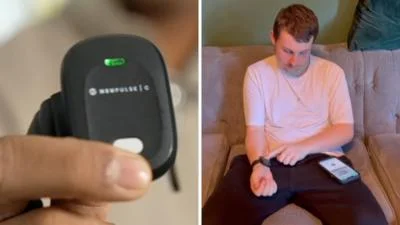
University of Nottingham researchers have developed a wearable device intended to reduce tics associated with Tourette syndrome. It applies electrical pulses to the median nerve at the wrist. BBC News
Key facts
The NHS describes Tourette syndrome as a condition involving repetitive sounds and movements that a person does not choose to make. BBC News
Neupulse, the University of Nottingham spin-out behind the product, identifies Professors Stephen Jackson and Georgina Jackson and Dr Barbara Morera among its research founders. BBC News
The company's website also carries his account of returning to education and working towards a future as an automotive mechanic after difficulties with school and socialising. BBC News
A wrist device offers a different way to manage tics
A 15-year-old from Cheshire has described the effect of a wrist-worn device developed from University of Nottingham research to help manage tics. Ollie had experienced involuntary neck movements for almost two years, according to a BBC video report showing the technology in use.
The device delivers electrical pulses to the median nerve at the wrist. Researchers are exploring how that stimulation affects brain activity involved in movement control, offering a non-invasive approach alongside the other ways people manage Tourette syndrome.
What Tourette syndrome involves
The NHS describes Tourette syndrome as a condition involving repetitive sounds and movements that a person does not choose to make. Vocal and motor tics can be affected by stress, excitement and tiredness, and symptoms usually begin during childhood.
Tics in a child do not automatically mean Tourette syndrome. An assessment considers their type, duration and age of onset, and a specialist may investigate whether another condition could explain the symptoms. Some people also have attention deficit hyperactivity disorder or obsessive compulsive disorder.
From university research to a wearable
Neupulse, the University of Nottingham spin-out behind the product, identifies Professors Stephen Jackson and Georgina Jackson and Dr Barbara Morera among its research founders. Its current Neupulse C is worn at the wrist and uses rhythmic median nerve stimulation.
The company markets this model as a wellness device intended to support calm and relaxation. That description should be kept separate from the BBC's account of a person living with tics: a commercial product description is not itself independent clinical evidence of effectiveness for every person with Tourette syndrome.
Ollie's experience is personal evidence
The BBC's report centres on the difference the device made for Ollie. The company's website also carries his account of returning to education and working towards a future as an automotive mechanic after difficulties with school and socialising.
Those experiences help explain the interest in a portable device that can be used during daily activities. They do not establish a universal response rate. The short BBC report does not provide enough trial information to calculate how many patients benefit, by how much or for how long.
Existing care still has a role
NHS guidance says there is no cure for Tourette syndrome, but treatment can help when tics cause problems. A clinician can discuss available approaches, including medicines, their possible side effects and any accompanying conditions that need attention.
Daily support also matters. The NHS highlights consistent routines, sleep and communication with a child's school. These measures address the setting in which someone lives with tics, rather than assuming that symptom management depends on one piece of technology.
What to establish before relying on a product
The manufacturer says its device can be personalised through an app and is currently supplied in the UK and Channel Islands. Availability in a shop or online does not answer questions about whether a particular person should use it or how it compares with their existing care.
For people interested after seeing Ollie's story, the useful next questions concern the evidence, suitability and the claims made for the exact model being sold. His experience demonstrates the human stakes of the research while leaving those individual treatment decisions with patients, families and clinicians.
Sources and editorial notes
This article compiles the linked reporting. Allegations, projections and research findings retain their original qualifications; this page does not represent independent field reporting or expert medical review.
November 17, 2026: Replaced repeated summary and FAQ templates, added source attribution and image description, and clarified the distinction between source publication and site edits. This editorial update is not an independent fact-check certification.