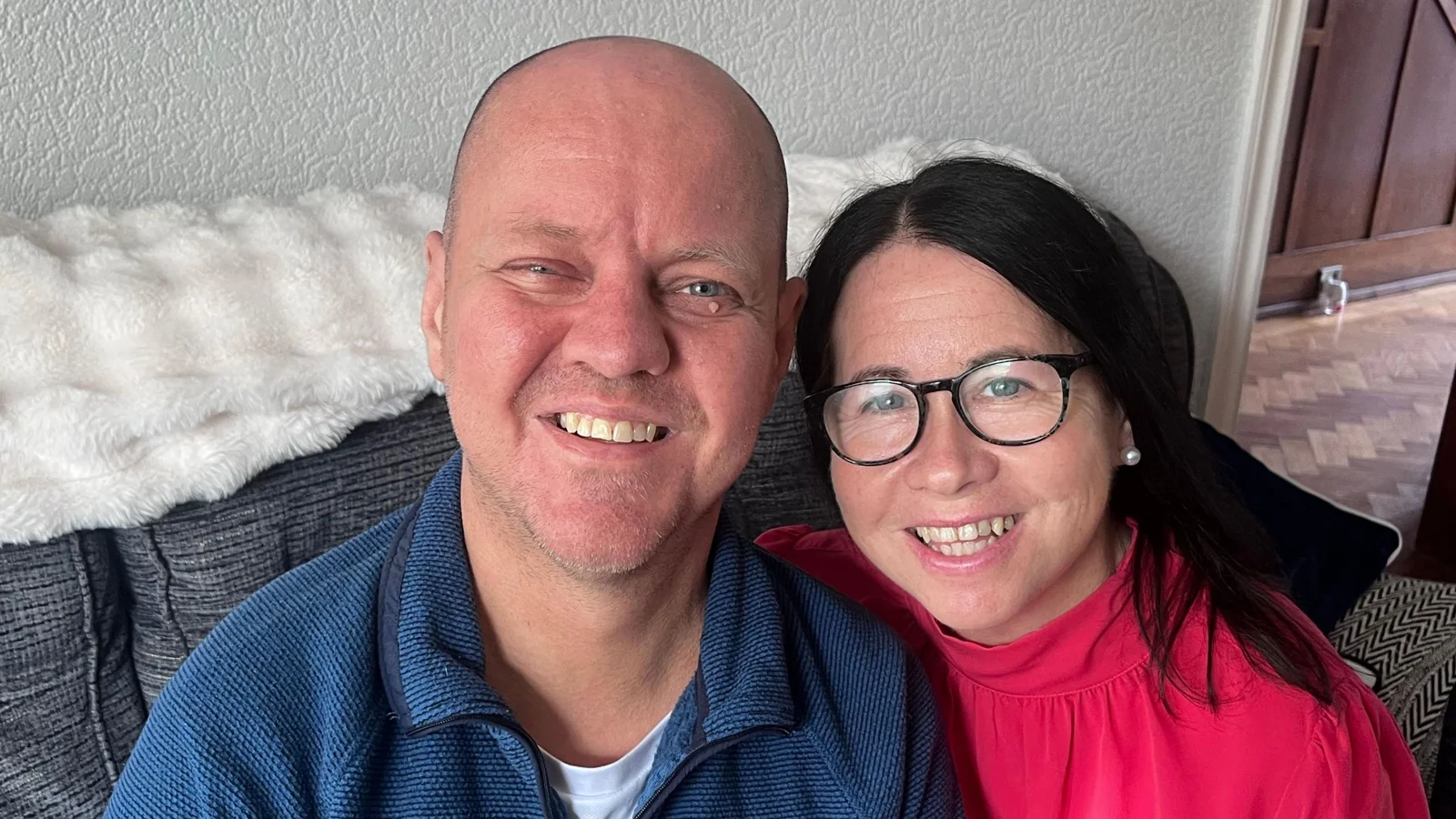
Image caption, Sean and Una Brown have been together 21 years, married for 16 of them
Belfast resident Una Brown donated a kidney to a stranger so that her husband Sean could receive a compatible organ from someone else. The couple took part in the UK Living Kidney Sharing Scheme. BBC News
Key facts
Sharing expands the pool beyond one family: a person unable to donate directly to their intended recipient may be suitable for someone else, while another donor can provide the compatible kidney their loved one needs. BBC News
Dr Hannah Magowan, a transplant surgeon at Belfast City Hospital, told the BBC that Northern Ireland has participated in the scheme since 2010, with almost 200 recipients benefiting. BBC News
Both Una and Sean were recovering well when they spoke to the BBC and hoped to return to work before Christmas. BBC News
A transplant made possible by another family
A Belfast couple have described how a kidney-sharing scheme allowed both of them to take part in a successful transplant even though they were not compatible donors for each other. Una Brown donated a kidney that travelled to Edinburgh, while her husband Sean received a compatible kidney in Belfast.
The BBC reported that the couple have been together for 21 years and married for 16. Their experience shows how a willingness to donate can benefit a loved one indirectly, through a coordinated exchange involving other patients and donors.
An unusually long first transplant
Sean, 45, received his first kidney transplant when he was eight. It lasted 37 years, carrying him from childhood into adult life before a further transplant became necessary. A new kidney offered the possibility of avoiding dialysis. Reporting context: BBC News
Una, 49, wanted to donate, but tests showed she was not a compatible match. That did not end the process. Instead, the couple entered the UK Living Kidney Sharing Scheme in July, allowing their circumstances to be considered alongside those of other donor-recipient pairs. Reporting context: BBC News
Matching beyond the household
The couple were matched in August. Sharing expands the pool beyond one family: a person unable to donate directly to their intended recipient may be suitable for someone else, while another donor can provide the compatible kidney their loved one needs.
For Una and Sean, that coordination involved different cities and teams. The kidney Una donated was flown to Edinburgh, and a compatible organ was brought to Belfast for Sean's operation. Neither the identity nor the detailed medical circumstances of the other recipient were disclosed in the report.
A last-minute change on surgery day
Their operations were scheduled for 8 October. That morning, a donor in the original three-way chain became unwell and the planned arrangement was cancelled. An alternative paired match was found, allowing the transplant to proceed. Reporting context: BBC News
The episode underlines the dependence of a sharing arrangement on every participant being well enough to undergo surgery. The backup match was decisive for this couple, but the report does not suggest that every disrupted chain can be rearranged in the same way.
A substantial contribution in Northern Ireland
Dr Hannah Magowan, a transplant surgeon at Belfast City Hospital, told the BBC that Northern Ireland has participated in the scheme since 2010, with almost 200 recipients benefiting. In 2025-26, 20 of its 69 living-donor kidney transplants were made possible through the scheme. Reporting context: BBC News
That is close to three in ten living-donor procedures. It is a local share of transplants, rather than the proportion of all patients on a waiting list who receive a kidney.
Recovery and the next stage
Both Una and Sean were recovering well when they spoke to the BBC and hoped to return to work before Christmas. Una also learned that the person receiving her kidney had been seriously ill and had undergone a successful transplant.
For the family, the outcome combines Sean's treatment with a benefit for someone they had never met. For the wider service, it is a concrete example of how organised matching can turn an incompatible offer of help into two completed operations.
How the national matching process operates
NHS Blood and Transplant runs a computer-assisted matching exercise four times a year to find combinations of potential transplants. The centres involved then carry out their own blood testing to confirm compatibility.
The aim is to complete the resulting transplants within ten weeks, although complexity or illness can alter the schedule. That national process explains how an incompatible family pair can become part of a much larger set of possible matches. It also shows why the arrangements remain provisional until the clinical checks and final preparations are complete.
Sources and editorial notes
This article compiles the linked reporting. Allegations, projections and research findings retain their original qualifications; this page does not represent independent field reporting or expert medical review.
- BBC News (reporting)
- NHS Blood and Transplant (reporting)
November 17, 2026: Replaced repeated summary and FAQ templates, added source attribution and image description, and clarified the distinction between source publication and site edits. This editorial update is not an independent fact-check certification.