QuantumScape has announced an all-solid-state battery platform using a sulphide electrolyte in its cathode. The company says early cells retained 80% capacity after 1,000 full cycles at approximately one atmosphere of pressure. Electrek
Key facts
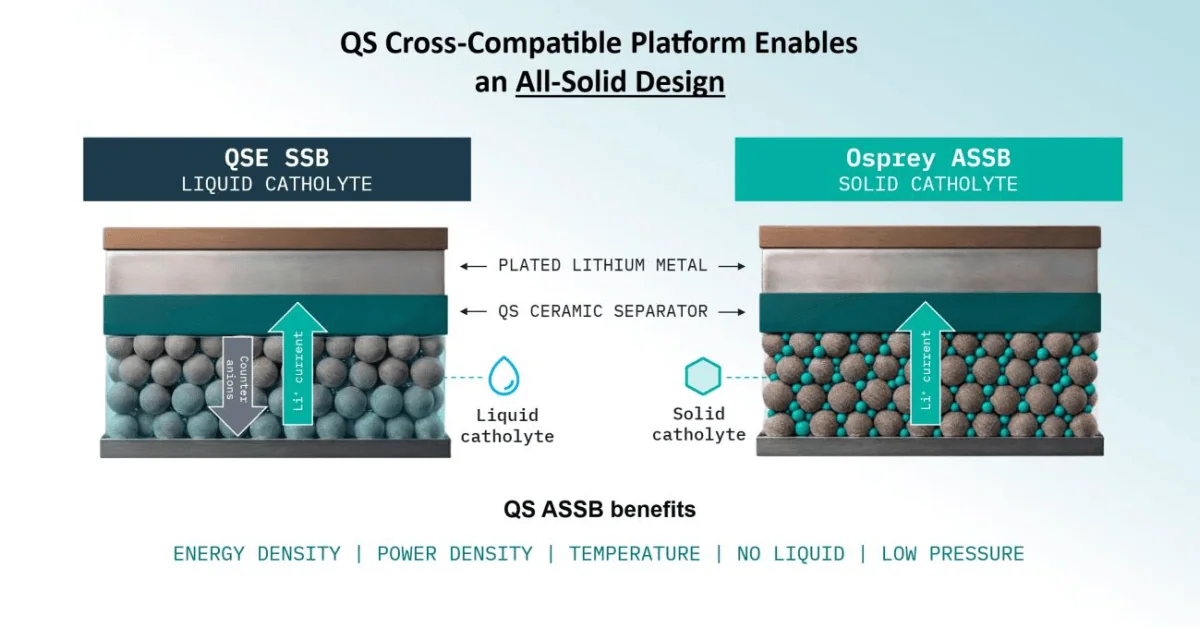
QuantumScape's Osprey platform retains the company's ceramic separator and anode-free approach but replaces liquid material in the cathode with a sulphide solid electrolyte. Electrek
The reported 1,000-cycle result came from a two-layer cell with a 50-by-65-millimetre cathode, tested at 30°C and one atmosphere of pressure. Electrek
Solid-state cells that require heavy compression need structures to maintain contact between their components. Electrek
QuantumScape separates a new platform from its current cells
QuantumScape has introduced Osprey, an all-solid-state research platform whose published cycling result combines a sulphide cathode with low operating pressure. Electrek examined the white paper behind the announcement and found both a significant technical result and important limits.
The development is best understood through the test conditions. Cycle life, charging speed, cold performance and projected energy density came from different experiments, which need to be assessed individually.
A chemistry change within the cell
QuantumScape's Osprey platform retains the company's ceramic separator and anode-free approach but replaces liquid material in the cathode with a sulphide solid electrolyte. That distinction matters because its existing QSE platform is not entirely solid-state. The announcement therefore concerns a new research direction as well as another performance result from an unchanged commercial product.
The cycling test has defined conditions
The reported 1,000-cycle result came from a two-layer cell with a 50-by-65-millimetre cathode, tested at 30°C and one atmosphere of pressure. Charging and discharging used a one-hour rate across the full state-of-charge range. Around 80% capacity remained. Publishing those conditions allows comparison, while also showing why the result cannot simply be described as a full-size automotive pack completing years of use. Reporting context: Electrek
Low pressure could simplify a pack
Solid-state cells that require heavy compression need structures to maintain contact between their components. Those structures add weight and space at pack level. QuantumScape's strategy keeps the sulphide in the cathode and uses its ceramic separator beside the lithium metal. The company's argument is that this division can preserve useful ionic conductivity without accepting all the pressure requirements of alternative sulphide arrangements.
Fast charging is a separate experiment
The five-minute charging demonstration was performed at 80°C on a small two-layer cell. A cold-weather result involved a still smaller single-layer cell discharged gently, while the highest energy-density figure is a projection associated with different conditions. These are distinct experiments, not a single cell simultaneously achieving every headline attribute. The distinctions are essential when judging what has actually been demonstrated. Reporting context: Electrek
Manufacturing remains an open task
The white paper describes laboratory-scale work and further process engineering still required. Osprey had no announced production timetable. QuantumScape is already scaling its separate QSE-5 programme, and a planned 100-MWh line targets 2028. A promising research platform must still gain layers, manufacturing throughput, consistency and customer qualification before a driver can buy a vehicle that uses it. Reporting context: Electrek
An open-platform strategy targets automotive partners
QuantumScape describes Osprey as an open platform: a customer could use the company's own sulphide cathode, made through a proprietary dry process, or bring a different one. It says solid cathodes from automotive customers have already been tested with the approach.
That would let the company offer its separator and anode-free design to manufacturers that have invested in sulphide materials, instead of requiring every component to come from the same development programme. The strategy fits an existing licensing approach involving Volkswagen's PowerCo and Honda. QuantumScape reported $9.8 million in customer billings in its third quarter. Those commercial relationships provide context for the research announcement, but neither billings nor partner names establish that Osprey has been qualified for a production vehicle. Reporting context: Electrek
Sources and editorial notes
This article compiles the linked reporting. Allegations, projections and research findings retain their original qualifications; this page does not represent independent field reporting or expert medical review.
- Electrek (reporting)
November 17, 2026: Replaced repeated summary and FAQ templates, added source attribution and image description, and clarified the distinction between source publication and site edits. This editorial update is not an independent fact-check certification.