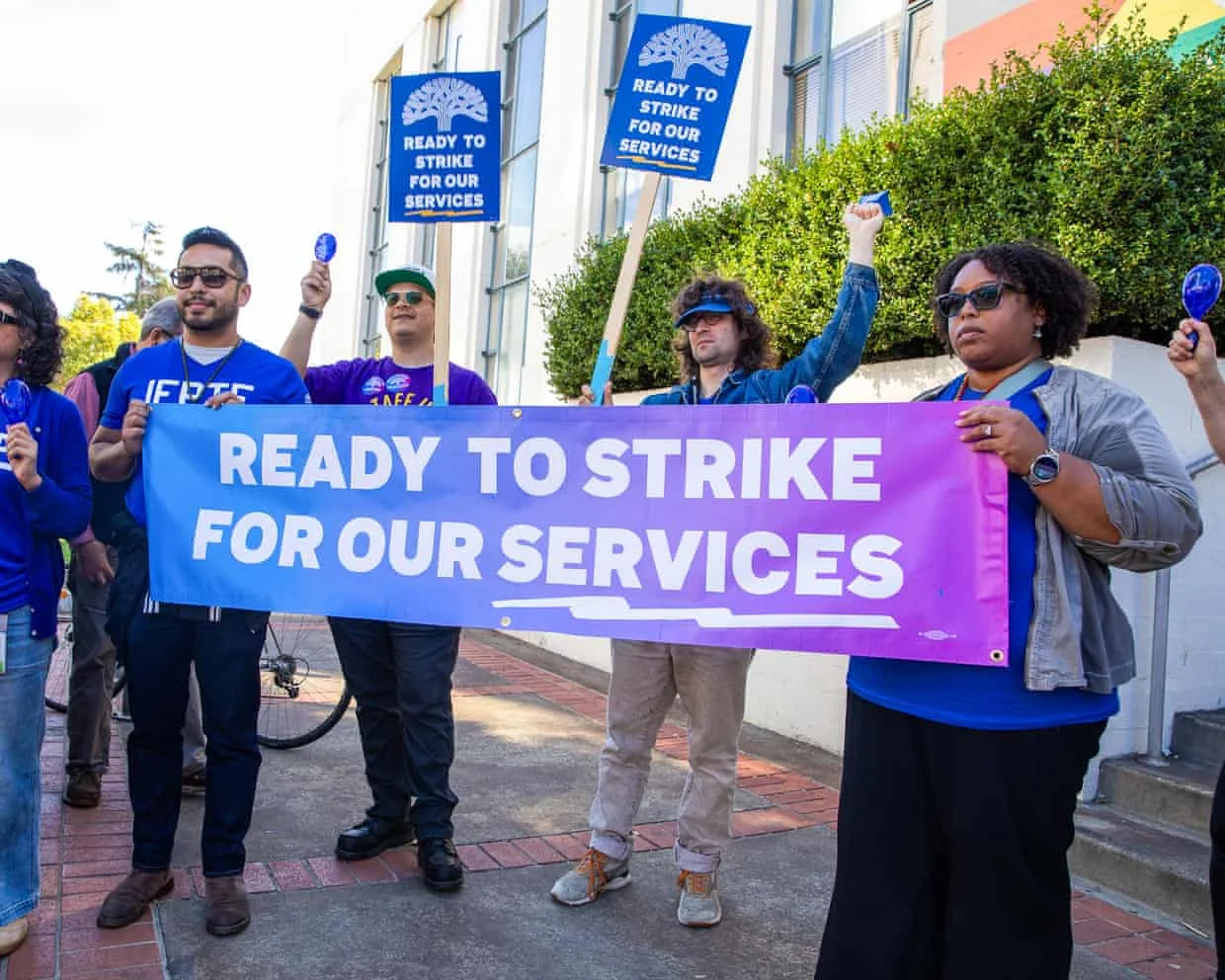
IFPTE members rally in Oakland, California, on 27 October. Photograph: Courtesy of IFPTE Local 21
An Oakland public-sector union has reached a tentative three-year agreement containing protections for employees affected by AI. The deal followed a strike-authorisation vote in which 94.1% of participating members voted in favour. The Guardian
Key facts
A tentative three-year agreement subsequently included protections for workers affected by AI, with retraining or reassignment taking precedence over dismissal. The Guardian
Systems can track location, rank performance, support hiring decisions or interpret activity data. The Guardian
Pennsylvania encouraged public employees to test ChatGPT Enterprise for tasks including unemployment and social-work administration. The Guardian
Workers negotiate over the way AI is introduced
American public-sector unions are using employment agreements to shape artificial intelligence in the workplace, from city services to transport. The Guardian reports that the bargaining concerns both replacement of jobs and the power to monitor or discipline the people who remain.
The resulting protections vary by employer. They turn an abstract debate about automation into specific decisions about consultation, retraining, accountability and the role of human staff in a public service.
Oakland converts pressure into a deal
Oakland's public employees authorised strike action on October 22 with 94.1% support. A tentative three-year agreement subsequently included protections for workers affected by AI, with retraining or reassignment taking precedence over dismissal. The planned November 5 strike was suspended. The sequence illustrates a concrete bargaining outcome, rather than a general promise that automation will never change public-sector employment. Reporting context: The Guardian
Monitoring becomes part of the dispute
The concerns extend beyond replacing an entire job. Systems can track location, rank performance, support hiring decisions or interpret activity data. A worker may remain employed but experience more intensive supervision or an opaque assessment process. Union representatives argue that advance notice and information about a system are necessary before staff can challenge its suitability or negotiate over how it is used.
Pennsylvania's pilot draws conditions
Pennsylvania encouraged public employees to test ChatGPT Enterprise for tasks including unemployment and social-work administration. SEIU Local 668 sought commitments about employee input, human supervision and protection against AI-based discipline. The union expects those questions to return in its 2027 negotiations. A pilot intended to measure saved time therefore also became a debate about who controls the results and their consequences. Reporting context: The Guardian
Transport unions separate assistance from replacement
The Transport Workers Union supports some technologies that improve collision avoidance or service timing while opposing the removal of trained staff from safety-critical roles. In Columbus, Ohio, its 2024 agreements gave it a say over proposed autonomous-vehicle deployment. This position is more specific than blanket opposition to technology: the dividing line concerns responsibility, oversight and employment protections. Reporting context: The Guardian
Contracts fill a policy gap
The Guardian's reporting describes unions using collective bargaining because broader regulation has not settled these workplace questions. A contract can specify consultation, reassignment or limits on surveillance for a defined group of employees. It cannot automatically protect workers outside that agreement. The growing importance of those clauses makes AI adoption a matter of labour relations and public-service governance as well as procurement.
California legislation adds another route to protection
A separate account from the Communications Workers of America describes new California laws alongside bargaining efforts. The union says the Right to Human Customer Service Act requires large businesses to provide timely access to human agents during business hours, while the No Robot Bosses Act requires human review and corroboration of automated disciplinary or termination decisions.
CWA also points to restrictions on workplace surveillance and a requirement that licensed professionals remain responsible for clinical healthcare decisions. These measures differ from an individual contract because their scope comes from state legislation. The union's account is a statement from an advocate for the laws, not independent evidence that every affected workplace has already changed its practices. Together with the city agreements, it shows workers pursuing several routes to influence how software is deployed.
Sources and editorial notes
This article compiles the linked reporting. Allegations, projections and research findings retain their original qualifications; this page does not represent independent field reporting or expert medical review.
- The Guardian (reporting)
- Communications Workers of America (reporting)
November 17, 2026: Replaced repeated summary and FAQ templates, added source attribution and image description, and clarified the distinction between source publication and site edits. This editorial update is not an independent fact-check certification.