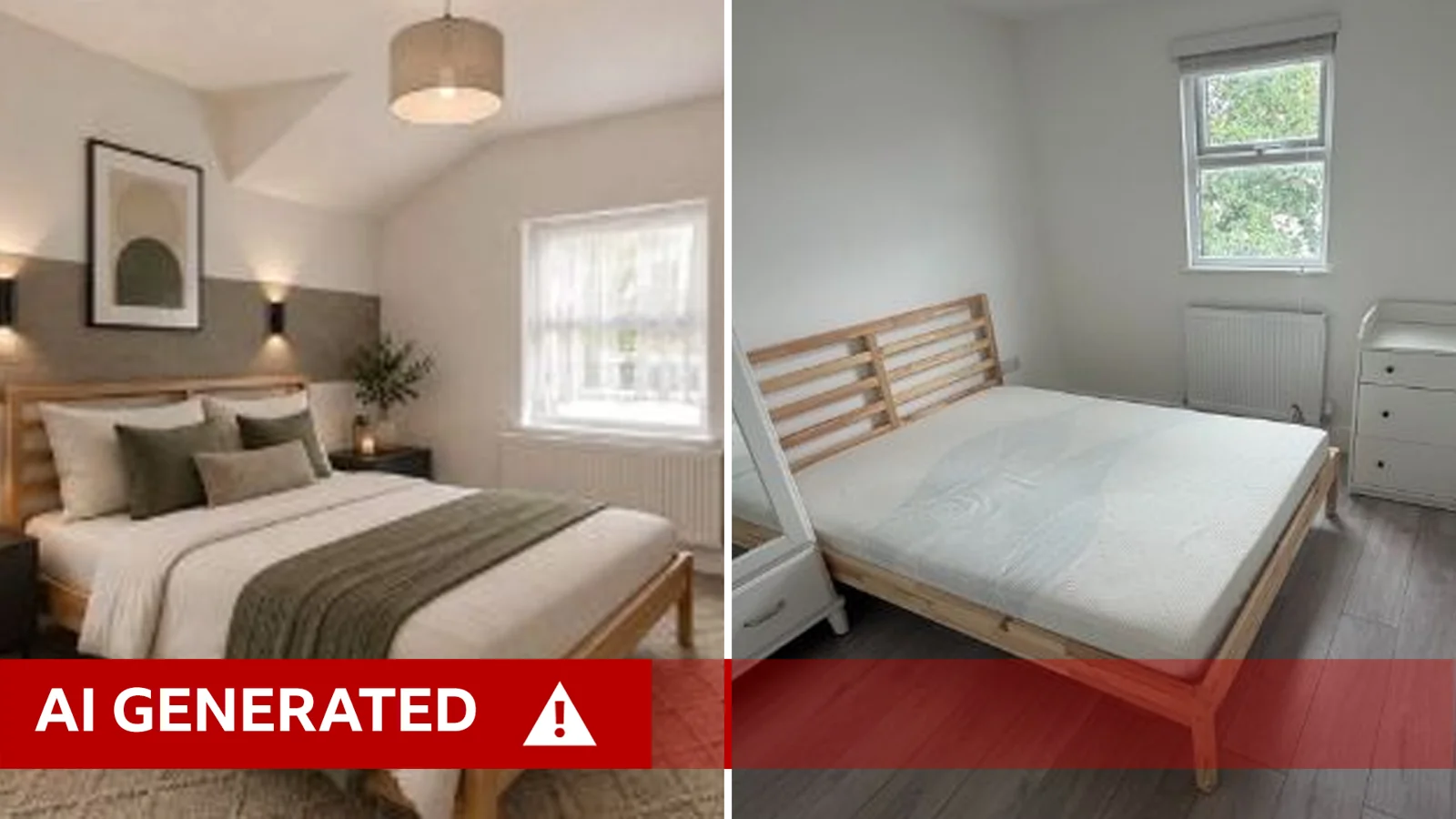
Source illustration comparing an AI-enhanced listing image (left) with the unenhanced room (right).
Estate agents are increasingly using AI to enhance property photographs, from changing wall colours to adding lawns. Buyers can struggle to tell whether an image shows an existing room or an imagined renovation. BBC News
Key facts
Olivia Nicole was searching for a five-bedroom home in south-west London when a listing caught her attention. BBC News
Housing Horrors creator Jack Bushrod considers decluttering or illustrating furniture in an empty room potentially useful. BBC News
Cara, who is selling a home in Lowestoft, found that her agent had emptied a child's room digitally and altered another bedroom image. BBC News
An attractive listing conceals a different home
AI-enhanced estate agency photographs are prompting questions about where presentation becomes misrepresentation. BBC News describes the practice as housefishing: prospective buyers arrive at a property that looks materially different from its online images. The technology can remove clutter, add furniture or change decor quickly, but it can also alter structural features. That makes the key distinction less about whether AI was used and more about what was changed and whether the buyer was clearly told.
A viewing that cost time away from work
Olivia Nicole was searching for a five-bedroom home in south-west London when a listing caught her attention. At the viewing, she found smaller-looking rooms, different decoration and structural details absent from the photographs. Windows appeared smaller in reality, and a raised wall section behind a sofa had disappeared online. She took comparison photographs and said the visit had required several hours away from work. The pictures appeared on Rightmove, Zoopla and Winkworth; all three told the BBC they had strict guidelines and subsequently removed them.
Digital staging is not the same as remodelling
Estate agents have long used lighting, wide-angle lenses and editing to make homes attractive. AI makes more extensive manipulation easier and more accessible. Housing Horrors creator Jack Bushrod considers decluttering or illustrating furniture in an empty room potentially useful. He objects to changes that conceal a defect or imply a feature exists when it does not, citing examples such as removing a pillar or adding a window. A buyer deciding whether to visit needs an accurate account of the property being offered, even when illustrations show possible improvements.
A seller encounters unexpected edits
Cara, who is selling a home in Lowestoft, found that her agent had emptied a child's room digitally and altered another bedroom image. She was comfortable with reasonable presentation but said she would object to structural changes or pictures that no longer resembled her home. Agent Howards acknowledged using AI and introduced a policy of labelling all enhanced photographs. It told the BBC that it did not use the tools to misrepresent fundamental property features. One altered image had already been removed.
Disclosure and accuracy both count
Trading Standards says basic enhancements or virtual furnishing can be acceptable when the use of technology is indicated. Structurally changing a room or hiding features could mislead consumers and breach the law. Labelling therefore addresses only part of the problem: an image described as AI-enhanced can still be misleading if it changes what is actually for sale. Bushrod wants disclosure to be prominent in a listing's key information rather than something a viewer discovers only after travelling to the property.
The scale is difficult to measure
The Guild of Property Professionals says the practice is hard to quantify and has issued guidance on responsible use. A survey cited by the BBC questioned 906 UK homebuyers; one in five recent purchasers said they had viewed a property whose photographs had been digitally improved. That finding concerns digital enhancement broadly, not a verified count of illegal AI manipulation. The practical issue is already clear from the examples: useful visualisation requires an honest separation between the present condition of a home and a possible future version. Reporting context: BBC News
Sources and editorial notes
This article compiles the linked reporting. Allegations, projections and research findings retain their original qualifications; this page does not represent independent field reporting or expert medical review.
- BBC News (reporting)
November 17, 2026: Replaced repeated summary and FAQ templates, added source attribution and image description, and clarified the distinction between source publication and site edits. This editorial update is not an independent fact-check certification.