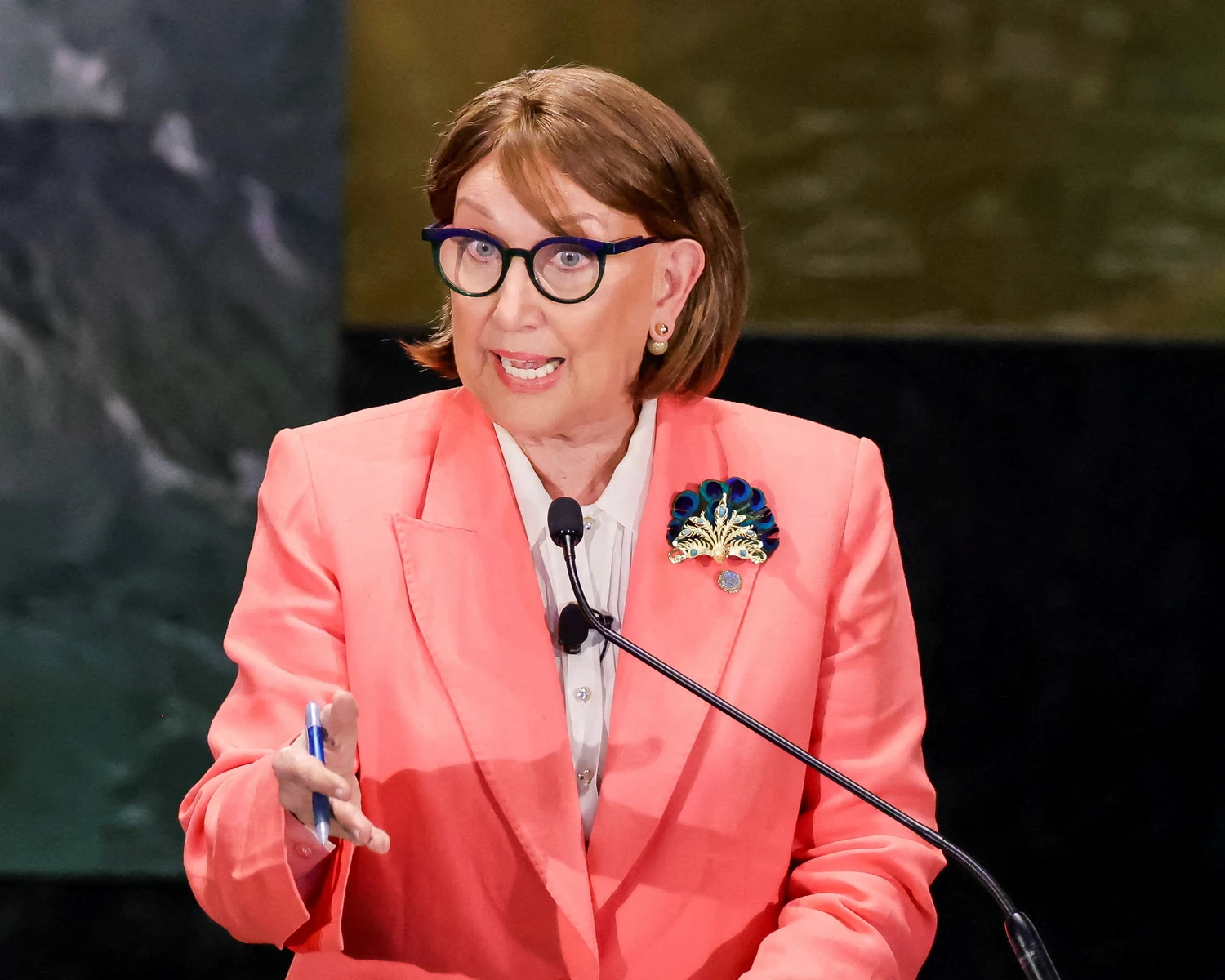
The UN succession contest turns on more than the total number of supportive votes. The Guardian’s account explains how a candidate with broad Security Council backing can still be blocked by a permanent member. Rebeca Grynspan’s early lead and Lana Nusseibeh’s diplomatic campaign therefore need to be read alongside the veto politics, not as a final election result. The Guardian
Why the Security Council vote matters
The race to become the next UN secretary general could reach a decisive moment on Friday when a UN security council vote is likely to reveal whether the Costa Rican frontrunner for the post would be blocked by the big powers. If so, the setback will reignite a debate about the dominance of the permanent five (P5) members at the United Nations.
The intensive lobbying over the job has spread across the globe, but Friday is especially important since the poll is slated to differentiate the voting of the P5 from the 10 elected members (E10) of the security council. To be recommended as secretary general to the UN general assembly, a candidate needs nine votes and no vetoes. In Friday’s colour-coded secret ballot, the P5 will cast red ballots and the E10 white.
One diplomat said: “The electoral system means it is important how many votes you win, but equally how many of certain votes you don’t lose.”
The protracted 140-day deadlock confirms the polarisation that has hampered the incumbent secretary general, António Guterres, but also belies claims the role is now an irrelevance.
Grynspan’s support and the permanent-member hurdle
Rebeca Grynspan, an economist and UN insider who is from a family of Polish-Jewish wartime refugees to Costa Rica, has been in the lead in all but one of the eight straw polls of the 15 UN security council members since the first secret ballot was held on 30 July. Each member goes down the list of candidates, casting an “encourage”, “discourage” or “no opinion” vote for each candidate.
Despite countries not being required to reveal how they voted, it is thought Grynspan’s candidature has been resisted by Russia and the US, two of the five permanent security council members that can ultimately wield a veto against a candidate. Knowledge among the security council delegations of how countries are voting is down to private intelligence, leaks and a process of elimination.
In the last ballot on 5 November, Grynspan won 12 votes in favour and three negative. But on 16 October – the only colour-coded ballot so far – which distinguishes between permanent and elected members – she received two discourage votes from permanent members, the equivalent of a veto. Nusseibeh had not joined the race at that point.
Nusseibeh’s campaign and the objections it faces
Friday’s secret ballot may also reveal whether the United Arab Emirates’ campaign for its diplomat, Lana Nusseibeh, is about to blow up in its face due to the hostility to the UAE’s brand of active, commercially driven diplomacy, not just in Sudan, but also Somalia, Western Sahara, Libya and Yemen.
A late entrant, in the two straw polls in which she has contested so far, Nusseibeh secured only seven “encourage” votes, six “discourage” and two “no opinions”. This is despite prestigious big-power backing and her acknowledged personal diplomatic skills.
Nusseibeh has US and Russian backing. The French foreign ministry may have misgivings about the UAE, but Emmanuel Macron, the French president, travelled to the UAE in the midst of French riots to see the UAE president, Sheikh Mohamed bin Zayed Al Nahyan, and secure 100,000 metric tons of diesel a month.
In the UK, the foreign secretary, Ed Miliband, has kept his counsel, but he shares a Polish-Jewish refugee heritage with Grynspan and cannot be an admirer of the UAE’s human rights record or its evasion of EU sanctions on Russia. The prime minister, Andy Burnham, has UAE connections from his time as mayor of Manchester, and Nusseibeh is a fellow alumnus of the University of Cambridge. At the UN she worked closely with the UK in an informal group called “Friends of the Future of the UN”.
Yet 68 British MPs, including the Labour chair of the international development select committee, Sarah Champion, last week signed a letter calling on Burnham to veto Nusseibeh, describing her as “a tainted and compromised figure”.
Some of the opposition to her from elected security council members is not wholly political. Latin American countries believe an informal rotation system means it is their turn to lead the UN. As a result Panama and Colombia, currently on the security council, will oppose her. China has also been supportive of this rotation principle.
But others deeply object to what they consider to be the UAE’s dollar diplomacy and preparedness to use its extraordinary wealth to exacerbate and exploit pre-existing divisions in a country to gain a commercial foothold. Somalia, for instance, has a seat on the Security Council, and its president, Hassan Sheikh Mohamud, this week went on TV to accuse the UAE of buying ports, establishing military bases and supporting armed forces outside Somalia’s national security framework without federal approval.
It is also possible that Finland and Latvia, the two elected members with the greatest stake in Ukraine, are unimpressed that the UAE gave Vladimir Putin red carpet treatment when he visited Abu Dhabi in December 2023, nine months after the international criminal court had issued an arrest warrant for child trafficking. Greece, less engaged in Ukraine, may be more flexible.
Since the last poll, Nusseibeh has been to Bahrain, Britain and Pakistan, a clue as to where extra votes may be harvested. She also had a “thoughtful exchange” with Zeng Jixin, the Chinese ambassador to the UAE.
The two hurdles are whether someone so deep inside the UAE inner circle would have the courage in office to show true independence, and whether her active denials of UAE involvement in arming the RSF in Sudan leave her irretrievably tainted. From a Palestinian intellectual family, she insists she would make peace in Sudan her number one priority.
Other candidates and the unresolved deadlock
In an administration as personalised as the US, it has been hard for Grynspan to gain influence, with many sensing that Mike Waltz, the US ambassador to the UN, is the key influencer.
Grynspan has been reluctant to make the fact she is Jewish a feature of her candidacy, but the election of a Jewish person to run the UN might be seen as something the US could embrace as transformative. Her age – she is 70 – could be considered a drawback among those calling for a younger generation to renew the institution.
Although there are other Latin American candidates, Grynspan is seen as a more viable candidate than her rival, the Argentine Rafael Grossi, the head of the UN weapons inspectorate. Russia has opposed Grossi, objecting to his interventions over the Zaporizhzhia nuclear plant in Ukraine.
One way or the other, the logjam has to be broken soon.
Frequently asked questions
Can a UN secretary-general candidate win simply by leading the straw polls?
No. Broad Security Council support does not overcome a permanent member's ability to block a candidate. The reported straw-poll lead is therefore not a final selection result. The Guardian
Why has Rebeca Grynspan's early support not settled the UN succession contest?
The article describes resistance believed to come from permanent members alongside her strong straw-poll performance. Veto politics and the acceptability of alternatives remain obstacles despite a high count of encouraging votes. The Guardian
Sources and editorial notes
This article compiles the linked reporting. Allegations, projections and research findings retain their original qualifications; this page does not represent independent field reporting or expert medical review.
- The Guardian (reporting)
November 23, 2026: Corrected section boundaries, removed extraction debris and repeated summary text where present, and clarified source attribution or image descriptions. This is an editorial repair of the cited reporting, not independent reporting, product testing or specialist fact-check certification. November 23, 2026: Added source-linked reader questions and answers based on the reporting already compiled in this article. These questions are editorial selections, not measured search queries.