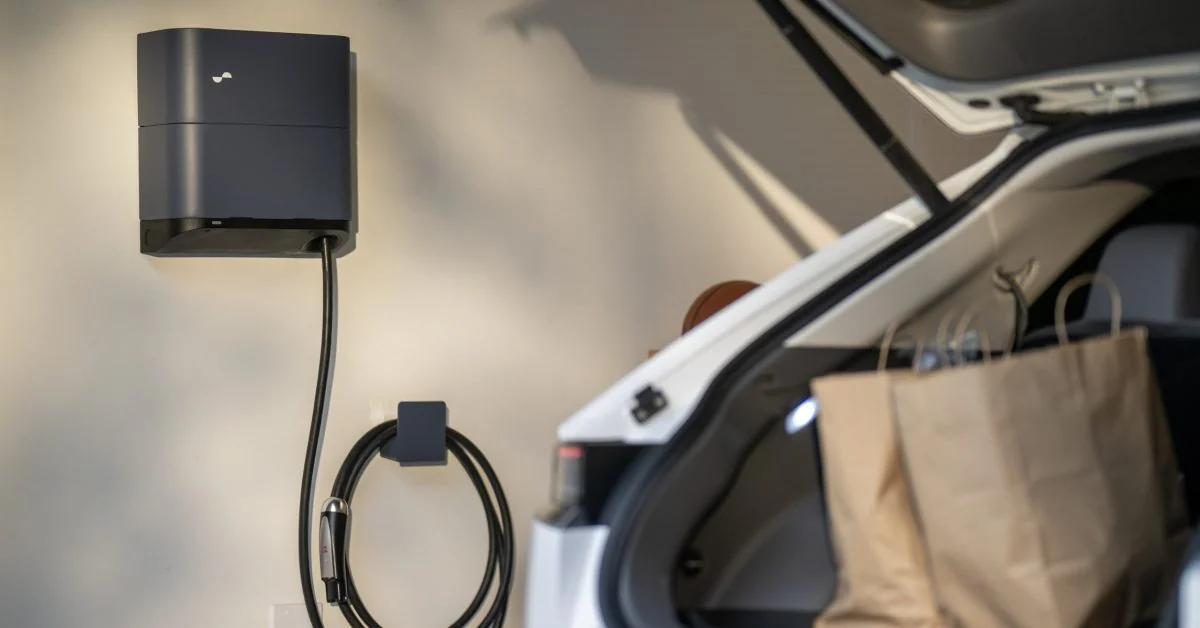
Lunar Energy has announced a 25-kW charger designed to work with its next-generation home battery system. The company plans to make the battery available in early 2027 and roll out the charger around the middle of the year. Electrek
Key facts
Lunar's proposed charger is a 25-kW DC unit connected to the DC side of its home-battery system. Electrek
The specifications list CCS and NACS support, but Lunar had not named the vehicles that would support bidirectional operation. Electrek
Lunar also describes configurations for small businesses, including larger pad-mounted systems. Electrek
An EV becomes part of a proposed home energy system
Lunar Energy has announced a home DC charger designed to work with its next-generation stationary battery and, where supported, send electricity in both directions. Electrek reports that the company wants an electric vehicle to contribute to household backup and energy management as well as receive a charge.
The announcement connects the driveway with a broader storage system, making compatibility and electricity-market arrangements central to the promised features.
Home charging meets stationary storage
Lunar's proposed charger is a 25-kW DC unit connected to the DC side of its home-battery system. The company says that arrangement can avoid an electrical-panel upgrade for the charger. Its estimate of roughly 100 miles added in an hour depends on the particular vehicle and conditions. A power rating describes the equipment's capability, not a guaranteed charging speed for every car. Reporting context: Electrek
Two-way operation needs more than a connector
The specifications list CCS and NACS support, but Lunar had not named the vehicles that would support bidirectional operation. A connector that lets a car receive electricity does not automatically let it supply a house. Vehicle-to-home backup also depends on controls and compatibility, while vehicle-to-grid exports require an available programme and the necessary arrangements with the electricity provider.
How the home system is configured
The updated system uses five-kWh battery modules and a 13.4-kW inverter. A tower can hold between ten and 30 kWh, with multiple towers expanding the installation. Lunar also describes configurations for small businesses, including larger pad-mounted systems. The range of possible sizes means a prospective installation needs to be matched to the property's loads and available space rather than selected solely by headline capacity. Reporting context: Electrek
Software coordinates the energy flows
Lunar says its controls consider electricity prices, weather and household consumption when choosing when to charge or discharge. Adding an EV would provide another store of energy alongside rooftop solar and a stationary battery. That could make more stored electricity available, but it also introduces the practical question of how much charge must remain in the vehicle for its next journey.
Price and timing remain important gaps
The new home-battery system is expected in early 2027, with the charger following around mid-year. Pricing and compatible bidirectional vehicle models had not been disclosed. Company-reported savings from existing customers describe a particular operating context, not a promised return for a new buyer. The product announcement therefore establishes intended capabilities while leaving the information needed for a household cost calculation incomplete. Reporting context: Electrek
Existing grid operations give the software a wider context
Lunar says its Gridshare platform already manages more than 150,000 distributed energy devices worldwide. The report identifies virtual-power-plant operations in California, Hawaii and Texas, with further expansion planned. Such programmes group many small resources so an electricity provider can call on them together. Reporting context: Electrek
The company also reported that California customers using its AI mode saved an additional $338 on average last year compared with a standard battery mode. That comparison concerns existing customers and operating conditions, rather than proving the return on the unpriced charger. The new hardware can work with new solar, existing solar or no solar, according to the announcement, and larger business configurations are described up to 1 MWh. The eventual value depends on the installation and local arrangements. Reporting context: Electrek
Sources and editorial notes
This article compiles the linked reporting. Allegations, projections and research findings retain their original qualifications; this page does not represent independent field reporting or expert medical review.
- Electrek (reporting)
November 17, 2026: Replaced repeated summary and FAQ templates, added source attribution and image description, and clarified the distinction between source publication and site edits. This editorial update is not an independent fact-check certification.