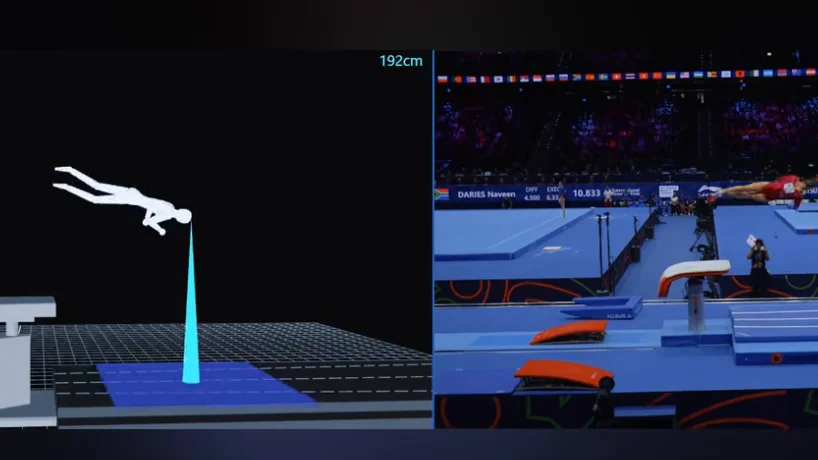
Image caption, AI-assisted judging was used at the recent World Gymnastics Championships
AI-assisted judging could play a role at the Los Angeles Olympics in 2028, according to gymnastics officials interviewed by BBC Sport. The technology was used at the recent World Championships, but its future Olympic deployment should not be treated as a completed decision. BBC Sport
Key facts
Fujitsu's Judging Support System, developed from 2017, was used at the World Gymnastics Championships in Rotterdam. BBC Sport
The debate became concrete when the piked Dragulescu vaults of Carlos Yulo and Harry Hepworth were downgraded in qualifying from a difficulty value of 5.6 to 5.2. BBC Sport
British judge Andrew Tombs told the BBC that judges would have reached the downgrading decision without the technology. BBC Sport
Judging technology moves closer to the medals
Artificial intelligence is becoming a more visible part of judged sport, but its possible role at the Los Angeles Olympics in 2028 remains a question rather than a confirmed replacement for officials. A BBC investigation describes systems being tested in gymnastics, aerial skiing and dressage. Their common ambition is to measure movements more consistently. Their difficulties also have something in common: a technically precise measurement still has to match the rule, the moment and the sporting quality judges are supposed to assess.
Gymnastics already has a working system
Fujitsu's Judging Support System, developed from 2017, was used at the World Gymnastics Championships in Rotterdam. The system analyses the body through video from multiple angles and can identify more than 800 elements. Its attraction is clear in a sport where the angle of a joint can distinguish one skill from another. Its function is to support decisions about what an athlete performed, while human officials continue to apply the sport's judging framework. Reporting context: BBC Sport
A vault exposes the difficult boundary
The debate became concrete when the piked Dragulescu vaults of Carlos Yulo and Harry Hepworth were downgraded in qualifying from a difficulty value of 5.6 to 5.2. Hepworth argued that bending the legs while preparing to land safely could be interpreted as performing the tucked version. That is more than an argument about a camera reading: it concerns precisely when a skill ends and landing preparation begins. In the final, Hepworth placed sixth and Yulo fell and finished seventh. Reporting context: BBC Sport
Better measurements still need sporting interpretation
British judge Andrew Tombs told the BBC that judges would have reached the downgrading decision without the technology. He also described work with coaches to refine the timing of measurements. Those positions can coexist: the system may support an existing decision while still needing clearer procedures. The episode does not demonstrate that every downgrade came from AI alone. It shows why athletes need to understand what is measured and why the selected instant represents the element being scored.
Other sports are testing different limits
In aerial skiing, the International Ski and Snowboard Federation has been piloting technology alongside judges, aiming to reduce the wait for a score. The reported ambition is a result in roughly 15 to 20 seconds, compared with an average delay of about one minute and 45 seconds, with wider implementation targeted for 2029. Dressage presents another problem. Technical positioning can be analysed, but the relationship between horse and rider and questions of welfare require additional forms of judgement and veterinary validation. Reporting context: BBC Sport
Los Angeles remains an open question
These experiments point towards more technological assistance, not a completed decision to let a machine award Olympic medals. Each sport has its own rules, camera requirements and contested qualities. The strongest case for a system will depend on whether athletes and officials can understand its decisions and whether it measures the intended action consistently. Rotterdam has already shown both the promise of detailed evidence and the consequences when a small physical distinction has a large effect on a score.
Sources and editorial notes
This article compiles the linked reporting. Allegations, projections and research findings retain their original qualifications; this page does not represent independent field reporting or expert medical review.
- BBC Sport (reporting)
November 17, 2026: Replaced repeated summary and FAQ templates, added source attribution and image description, and clarified the distinction between source publication and site edits. This editorial update is not an independent fact-check certification.