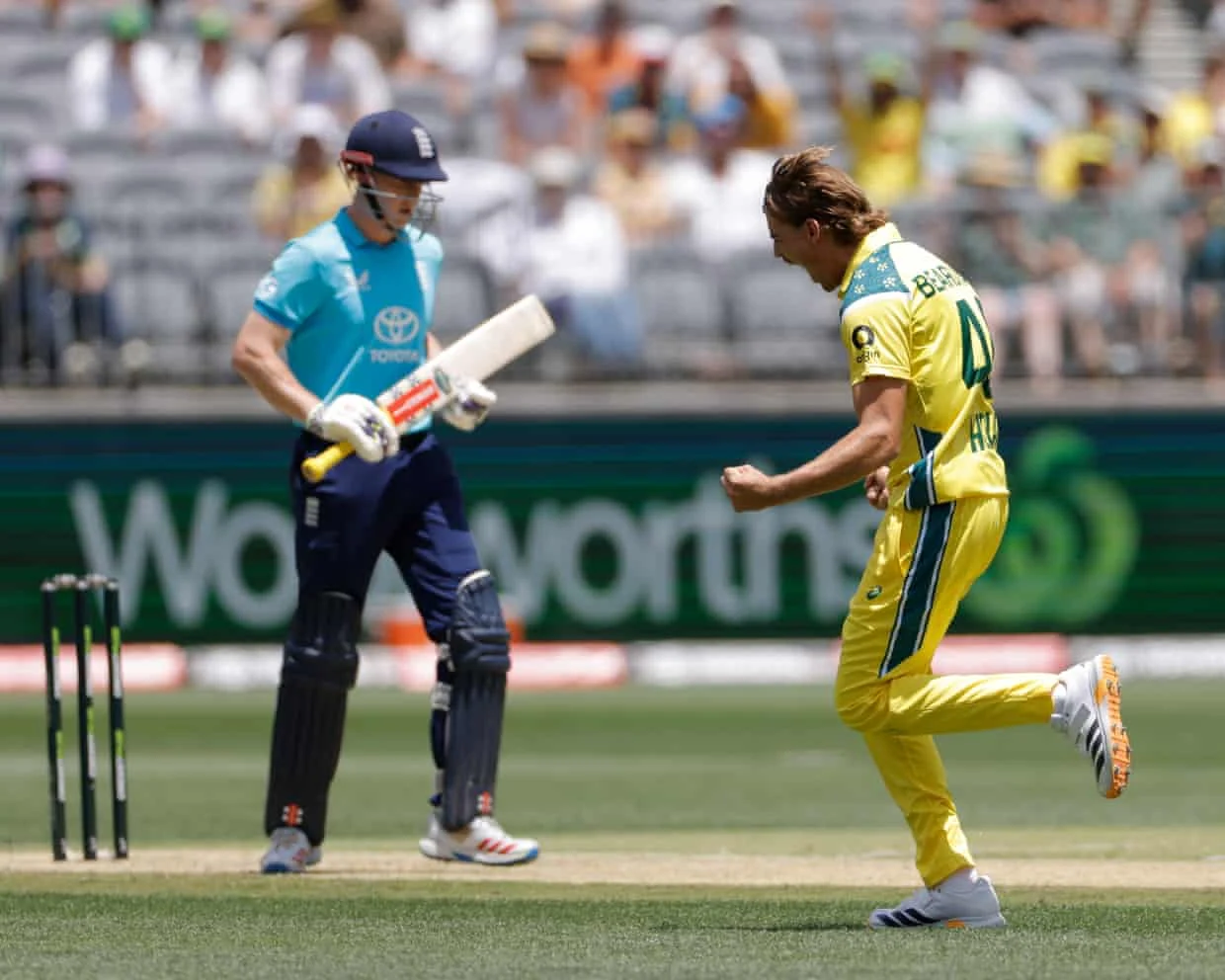
Australia beat England by seven wickets in the first men's one-day international in Perth. The hosts completed the chase in 23.3 overs, leaving more than 26 overs unused and making a decisive start to the series. The Guardian
Key facts
Mahli Beardman’s debut bowling return surpassed Tony Dodemaide’s five for 21 against Sri Lanka in 1988 as Australia’s best on a men’s ODI debut. The Guardian
Josh Inglis took five catches behind the stumps and Jack Edwards took three in the field against England. The Guardian
Australia won the first ODI in Perth by seven wickets; the result is one match in a longer series. The Guardian
A debut that decided the match
Australia beat England by seven wickets in the first men's one-day international in Perth, with Mahli Beardman's opening appearance becoming the defining performance. The Guardian's live coverage recorded Australia reaching 132 for three in 23.3 overs after England's innings had collapsed. A chase completed with more than 26 overs unused made the margin unusually emphatic, even before considering the individual record established by the home side's 21-year-old fast bowler.
Beardman sets an Australian mark
Beardman took six wickets for 24 runs from 7.4 overs. Those figures surpassed Tony Dodemaide's five for 21 against Sri Lanka at the WACA in 1988 as Australia's best return on a men's ODI debut. The achievement combined immediate impact with sustained pressure: England repeatedly lost batters through edges outside off stump, allowing Australia to turn promising bowling positions into completed dismissals. A debutant's spell supplied the clearest explanation for why the target stayed so modest. Reporting context: The Guardian
The catching made the pressure count
Josh Inglis collected five catches behind the stumps, while Jack Edwards took three in the field, including two at gully off Beardman. Those details are an essential part of the bowling story. Edges do not automatically become wickets, and a side that holds a sequence of chances can convert movement and uncertainty into a rapid collapse. Australia's catching gave England little opportunity to survive the dangerous passages and rebuild through a missed chance.
Marsh removes the tension from the chase
Mitchell Marsh made 50 from 29 balls, striking four fours and four sixes. His pace immediately reduced the possibility that a small target would nevertheless create an awkward pursuit. Inglis added 23, while Matt Renshaw finished unbeaten on 26. Australia lost three wickets, but its scoring rate meant that those interruptions did not translate into a sustained contest over the required run rate. The chase was finished before the halfway point of a normal 50-over innings. Reporting context: The Guardian
England's attack had little room to recover
Gus Atkinson completed ten overs for 40 runs and one wicket, and Jofra Archer dismissed Cooper Connolly. Those contributions could interrupt the chase but could not undo the batting deficit. Once Marsh had accelerated, Australia had considerable time to absorb a wicket or a quiet over. England's central problem was therefore established in its own innings: the bowlers were defending a total that demanded an exceptional sequence of dismissals to become competitive. Reporting context: The Guardian
A clear result, with a longer series ahead
One match cannot establish how Beardman will perform throughout an international career, but it can establish the scale of this first appearance. Six wickets, a national debut record and a comfortable team victory give Australia a substantial opening result. For England, the immediate cricketing questions concern how batters handle the line outside off stump and how the side builds a defendable innings. The next match provides a fresh test; the Perth scorecard already supplies a decisive account of the first.
Sources and editorial notes
This article compiles the linked reporting. Allegations, projections and research findings retain their original qualifications; this page does not represent independent field reporting or expert medical review.
- The Guardian (reporting)
November 17, 2026: Replaced repeated summary and FAQ templates, added source attribution and image description, and clarified the distinction between source publication and site edits. This editorial update is not an independent fact-check certification.