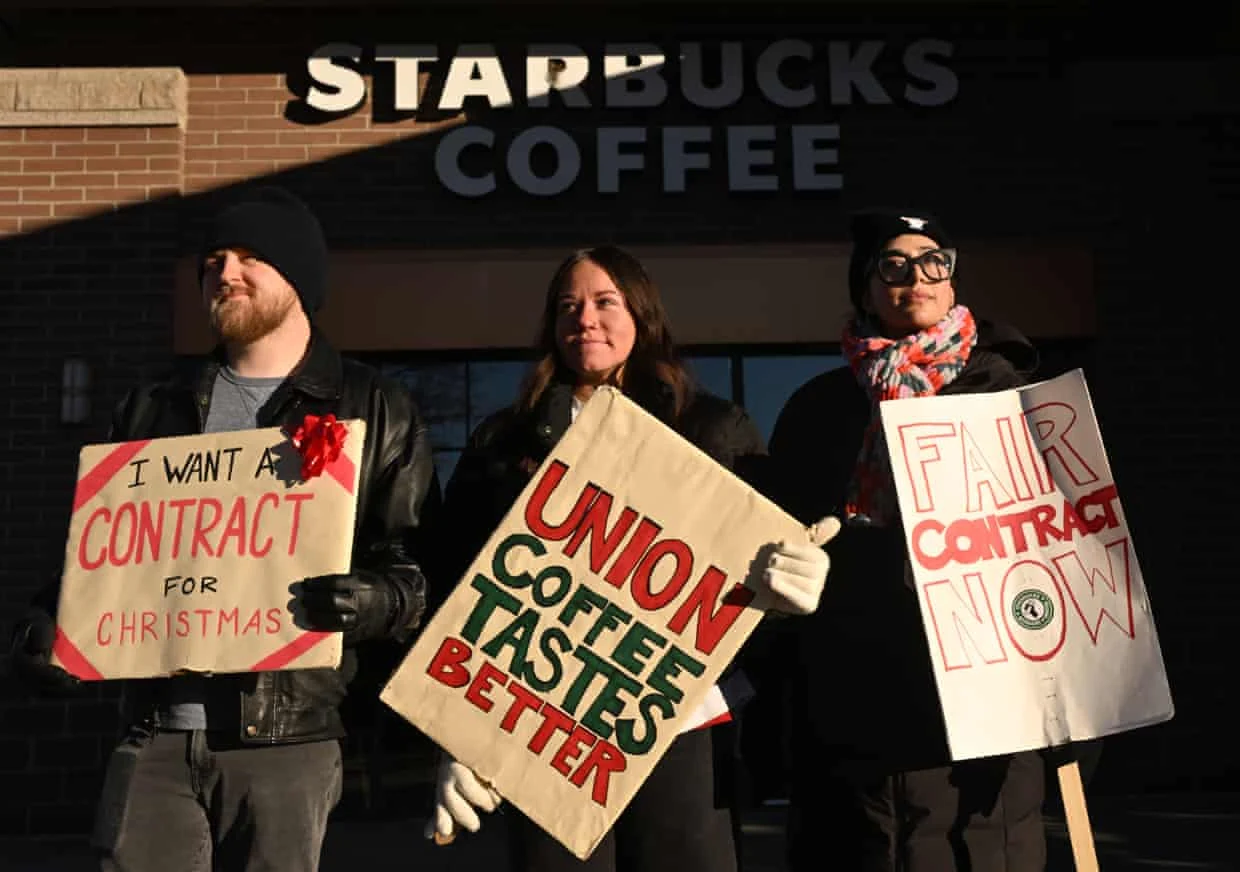
Students and labour supporters planned demonstrations at more than 40 US college campuses in support of Starbucks Workers United. The union is asking consumers to boycott the chain until a first collective contract is reached. The Guardian
Key facts
The union is seeking a minimum hourly wage of $17 for baristas and at least three workers on duty per store. The Guardian
The Guardian notes that reaching a first agreement commonly takes more than 450 days, while this campaign has lasted considerably longer. The Guardian
The union began focusing on colleges in 2023, asking them to end contracts in response to Starbucks' handling of organising. The Guardian
Campus rallies widen a long-running labour campaign
Starbucks workers and supporters planned events at more than 40 US college campuses on Thursday as their union pressed for a first contract. The Guardian reports that Starbucks Workers United is asking consumers to boycott the chain until an agreement is reached. The first store voted to organise in Buffalo, New York, in December 2021. Nearly five years later, the dispute has become both a workplace negotiation and a campaign aimed at the company's customers and institutional partners.
Pay, staffing and job security are central
The union is seeking a minimum hourly wage of $17 for baristas and at least three workers on duty per store. Worker Andrew Trinklein, participating in an event at the University of Texas at Austin, also emphasised protection from dismissal without just cause. He described the uncertainty of working without those negotiated safeguards. These demands involve different aspects of employment: hourly pay, the number of colleagues available to handle work and the procedures governing discipline. Progress in one area would not by itself resolve all three. Reporting context: The Guardian
Organising has spread beyond the first store
More than 700 Starbucks locations, representing over 12,000 baristas, have voted to unionise. The Guardian notes that reaching a first agreement commonly takes more than 450 days, while this campaign has lasted considerably longer. A vote to organise does not automatically produce a contract, and the continued absence of one is what the union is using to mobilise customers. The company says Workers United represents approximately 5% of its US workforce, placing the organised locations within a much larger national operation. Reporting context: The Guardian
Universities are a source of commercial pressure
The union began focusing on colleges in 2023, asking them to end contracts in response to Starbucks' handling of organising. Cornell and Pomona College subsequently did not renew their agreements, while UCLA stopped offering Starbucks products in its cafes. The planned rallies include the University of Pennsylvania, Northwestern and the University of Washington. Campus purchasing decisions create a different pressure point from an individual customer's choice, because universities can influence recurring supply or service relationships as well as public debate. Reporting context: The Guardian
Negotiations resumed and then stalled again
The union and company agreed on a path forward in February 2024, temporarily pausing some pressure tactics. The Guardian reports that negotiations later broke down after Brian Niccol became chief executive. Federal labour authorities have found Starbucks in violation of labour law in several organising-related cases; the company has challenged those rulings. Those disputes provide context for the lack of trust, but each case has its own facts and status. They do not replace the need for bargaining over a first contract. Reporting context: The Guardian
Starbucks disputes the campaign's characterisation
The company says the demonstrations divert attention from negotiations and does not anticipate meaningful disruption during the holidays. It points to compensation and benefits it says average more than $30 per hour in total value, including healthcare, tuition coverage, stock and paid parental leave for qualifying workers. That total-benefits claim is different from a minimum cash wage. The rallies come before Red Cup Day on 17 November, connecting the union's public campaign to a busy sales period while the underlying disagreements remain unresolved. Reporting context: The Guardian
Sources and editorial notes
This article compiles the linked reporting. Allegations, projections and research findings retain their original qualifications; this page does not represent independent field reporting or expert medical review.
- The Guardian (reporting)
November 17, 2026: Replaced repeated summary and FAQ templates, added source attribution and image description, and clarified the distinction between source publication and site edits. This editorial update is not an independent fact-check certification.