Key facts
UN Secretary-General António Guterres has warned that the world is approaching a moral red line if AI-powered drones can kill without human involvement. CBC News
Experts interviewed by CBC argue that the most urgent question may be how AI decides where and when to strike, rather than the final act of pulling a trigger. CBC News
Paul Lushenko of Cornell University’s Tech Policy Institute told CBC that military leaders fear losing an advantage if competitors do not follow the same rules. CBC News
Diplomats return to the autonomous-weapons question
Delegates from more than 100 countries are meeting in Geneva under the UN Convention on Certain Conventional Weapons to discuss lethal autonomous weapons systems. CBC News reports that the agenda includes the possibility of a regulatory framework, but expectations for a binding agreement are low. The talks cover systems that could select or engage targets with limited or no direct human intervention. Reporting context: CBC News
The moral red line is moving closer
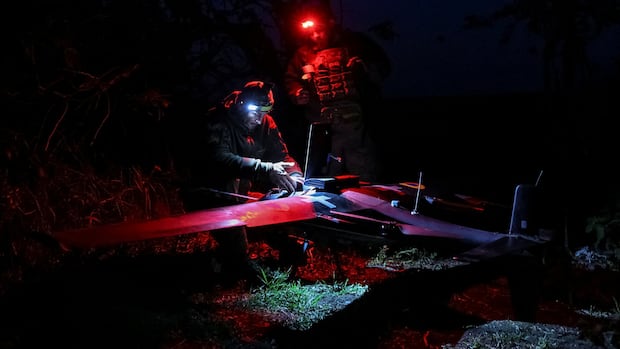
UN Secretary-General António Guterres has warned that the world is approaching a moral red line if AI-powered drones can kill without human involvement. He has called for a legally binding treaty by the end of 2026. The concern is not limited to a futuristic battlefield: Ukraine and Russia are already using increasingly automated systems, and AI is being applied to intelligence, surveillance and target selection. Reporting context: CBC News
UN and ICRC appeal on lethal autonomous weapons (25 August 2026)
The hardest issue may happen before a weapon fires
Experts interviewed by CBC argue that the most urgent question may be how AI decides where and when to strike, rather than the final act of pulling a trigger. A model that prioritises targets or fuses large amounts of sensor data can shape a military decision even when a person formally authorises the attack. That makes accountability harder to trace and raises questions about data quality, bias and the ability of commanders to understand a recommendation quickly enough.
A security dilemma blocks common rules
Paul Lushenko of Cornell University’s Tech Policy Institute told CBC that military leaders fear losing an advantage if competitors do not follow the same rules. The result resembles a Cold War stalemate: governments recognise the ethical risks but hesitate to constrain systems that might improve battlefield speed or accuracy. The United States, Russia and China have so far resisted serious binding limits, leaving voluntary declarations with uneven participation.
The next test is verification, not slogans
A workable treaty would need definitions, human-control requirements, testing standards and a way to investigate violations. Previous negotiations have shown how quickly safety language can disappear in the final drafting stage. The Geneva meeting may therefore produce more value through transparency commitments and shared terminology than through a dramatic announcement. Without a mechanism to verify what systems can do in practice, a promise of human control remains difficult to assess. Source: CBC News
Frequently asked questions
Is there already a binding UN treaty on autonomous weapons?
Not in this report. More than 100 countries were discussing rules, while major military powers remained reluctant to accept binding limits. Calls for a treaty by the end of 2026 are not evidence that one has been concluded. CBC News
Why do accountability concerns remain when a human approves the target?
AI can shape which targets a commander sees and prioritises before a weapon fires. CBC’s report describes concerns about accountability, bias and human understanding even where a person formally authorises an attack. CBC News
Sources and editorial notes
This article compiles the linked reporting. Allegations, projections and research findings retain their original qualifications; this page does not represent independent field reporting or expert medical review.
- CBC News (reporting)
- UN and ICRC appeal on lethal autonomous weapons (25 August 2026) (primary)
November 17, 2026: Replaced repeated summary and FAQ templates, added source attribution and image description, and clarified the distinction between source publication and site edits. This editorial update is not an independent fact-check certification. November 23, 2026: Added source-linked reader questions and answers based on the reporting already compiled in this article. These questions are editorial selections, not measured search queries. November 24, 2026: Revised the FAQs to prioritise reader impact and practical questions using the cited material. The original reporting date is unchanged.