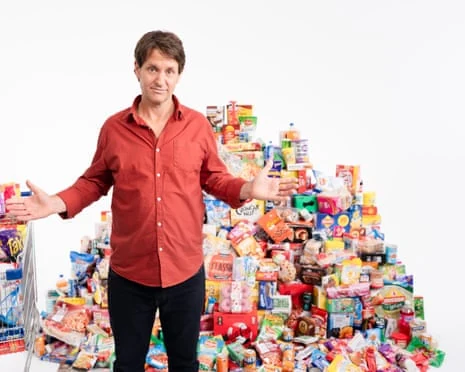
ABC presenter Craig Reucassel ate an extra 1,500 calories of ultra-processed food daily for five days for The Great Food Con, according to a Guardian interview. The demonstration is a personal documentary experiment, not a controlled trial proving the effect of all ultra-processed foods. WHO’s guideline-development notice provides a separate account of the wider evidence question. Processing level, nutrient content, total intake and affordability all matter when interpreting the programme.
Key facts
The documentary experiment added 1,500 calories per day for five days.
The Guardian reports Reucassel’s experience and a before-and-after brain scan.
The intervention changed both food type and energy intake.
WHO has described a guideline-development process, not a verdict on every packaged product.
What the documentary’s experiment involved
In the Guardian interview, Craig Reucassel describes eating an additional 1,500 calories of ultra-processed food each day for five days while making ABC's The Great Food Con. The account includes snacks and convenience foods added to his usual meals, his reported discomfort, and a before-and-after brain scan used in the programme.
Those details describe a television demonstration involving one person. They should stay attached to that context. The programme can make a food-system question vivid without functioning as a large randomised clinical trial. A striking scene or personal account is an entry into the topic, rather than a numerical estimate of what will happen to every viewer.
Why the added calories matter to the conclusion
The experiment changes more than one thing. Reucassel increases his consumption of ultra-processed foods while also substantially increasing total energy intake. Without a suitable comparison, the account cannot isolate which change explains each reported effect. This is a limitation of what the demonstration can establish, not a claim that his experience did not happen.
It is particularly important when interpreting a brain-scan result. A reported before-and-after difference does not independently demonstrate long-term clinical harm, reversibility or the response of a wider population. Those questions need studies designed to answer them. The documentary should not be promoted as having resolved all of them in five days.
Why “processed” and “ultra-processed” need care
The WHO guideline-development notice explains that food processing has long been used to make food edible, safer or easier to store. It distinguishes that broad history from more substantial industrial transformations and the evidence questions around ultra-processed foods. Processing itself is therefore not a useful synonym for harmful food.
The Guardian notes debate over definitions and examples that extend beyond familiar sweets or fast food. An ingredient list can be informative, but a universal rule that any unfamiliar word proves danger would be too simple. Composition, the place of a food within the overall diet and the purpose of processing all remain relevant.
What WHO’s notice adds to the television account
WHO describes bringing together a guideline-development group to review the available evidence and develop global guidance. Its notice explains the expert-selection and conflict-of-interest process. That is an institutional research and guideline pathway, distinct from one presenter's documentary challenge.
The notice refers to associations between highly processed diets and adverse health outcomes, but its existence does not let a reader infer a completed new recommendation for every product. When citing it, the important distinction is between the process of reviewing evidence and a final guideline with specific recommendations. This article does not present the former as if it were the latter.
Why the programme is also about marketing and access
The Guardian interview describes the series examining food engineering, marketing and the difficulty of recognising ultra-processed products in apparently health-oriented shopping categories. That focus makes the subject broader than whether an individual has enough willpower to avoid a snack. Product availability, price, convenience and the information on a package all influence choices.
Those conditions also limit what a simple personal challenge can answer. A costly or time-intensive alternative may not be realistic for every household. Evaluating food policy requires asking what people can actually obtain and afford, alongside what a label says. The documentary's public-policy questions should not be reduced to blame directed at individual shoppers.
A practical way to read the next headline
When another report cites the five-day experiment, first ask whether it is describing Reucassel's experience, a clinical study or a population-level association. Then ask what was actually changed, which outcome was measured and how long the observation lasted. These questions make it easier to distinguish an engaging illustration from evidence supporting a general health claim.
Readers seeking personalised nutrition or treatment guidance need more than a television account. The sources here support discussing the food environment and taking research into processing seriously. They do not justify a self-directed extreme eating experiment or a claim that all packaged foods carry the same risk.
Frequently asked questions
Do I need to avoid all processed food?
No. WHO’s notice explains that processing can improve edibility, storage and safety. The more specific question concerns particular industrially transformed foods and dietary patterns. “Processed” is too broad to act as a universal health verdict.
Does the five-day experiment show what will happen to my brain?
No. The Guardian interview describes one presenter’s experience and scans in a documentary. It does not establish a general effect size, long-term outcome or the response of every person.
Why does eating an extra 1,500 calories complicate the experiment?
It means the intervention changed total intake as well as the foods eaten. That limits how confidently a particular effect can be assigned to processing alone. It is an interpretation of the experiment described in the interview, not a finding from a separate trial.
Has WHO issued new rules banning ultra-processed foods?
No. The notice reviewed here concerns developing guidance and selecting the group reviewing evidence. It is not a product ban or a completed new recommendation covering every packaged food.
At a glance
| Issue | Verified position | Limit or next step |
|---|---|---|
| Documentary intervention | Five days with 1,500 extra calories daily | One person; multiple changes at once |
| Reported scan | Before-and-after observation described | Not a general clinical outcome |
| WHO document | Guideline-development process | Not a product ban or completed verdict |
| Consumer interpretation | Food type and overall intake both matter | Avoid treating all processing as equivalent |
Sources and editorial notes
This article compiles the linked reporting. Allegations, projections and research findings retain their original qualifications; this page does not represent independent field reporting or expert medical review.
- The Guardian (reporting)
- World Health Organization (primary)
Published on 24 November 2026 after reviewing the linked sources. This is an independently worded editorial synthesis, not an original interview or field report. Earlier articles remain dated historical coverage. November 24, 2026: Revised the FAQs to prioritise reader impact and practical questions using the cited material. The original reporting date is unchanged.