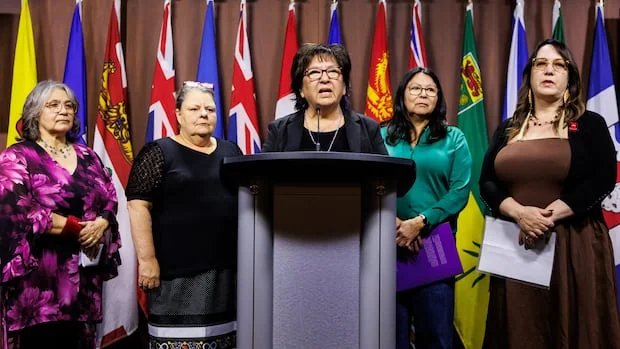
Indigenous women's organisations gathered in Ottawa to argue that Canada's new federal budget fails to address their safety and participation. Native Women's Association of Canada president Josie Nepinak called it a missed opportunity for sustained investment in healing. CBC News
Key facts
The budget promises C$50 billion over ten years for Indigenous programmes and services, including C$32 billion for First Nations housing and infrastructure. CBC News
Rose Mary Cooper said most communities in Inuit Nunangat are accessible only by air and that 60% lack shelters or other safe spaces. CBC News
Ontario Native Women's Association chief executive Cora McGuire-Cyrette cited the organisation's 2024 research indicating that 83% of Indigenous women live off reserve in rural or urban centres. CBC News
Indigenous women's groups challenge Canada's budget priorities
Indigenous women leaders gathered in Ottawa to argue that the Carney government's new budget fails to reflect their safety needs and excludes them from important decisions. CBC News reports criticism from First Nations, Inuit and Métis organisations. Native Women's Association of Canada president Josie Nepinak described a missed opportunity for sustained investment in safety and healing. Their objection concerns both where money goes and whether the women affected have a meaningful role in designing the response.
A large spending pledge does not settle distribution
The budget promises C$50 billion over ten years for Indigenous programmes and services, including C$32 billion for First Nations housing and infrastructure. Inuit Tapiriit Kanatami welcomed C$575 million over five years for the Inuit Child First Initiative and its transition to the Inuit-led Pirutsiagutiit programme. It nevertheless criticised missing Inuit-specific references elsewhere. Métis representatives also objected to the absence of distinct funding. The debate is therefore about the fit between broad commitments and different communities, rather than a claim that the budget contains no Indigenous investment. Reporting context: CBC News
Northern geography changes what safety requires
Rose Mary Cooper said most communities in Inuit Nunangat are accessible only by air and that 60% lack shelters or other safe spaces. A woman escaping violence may therefore have to leave her language, relatives, land and local support network. Food, housing and transport costs further complicate assistance. Her argument is that an urban service model cannot simply be transferred to small remote communities. Programmes need to be designed and led by women who understand those conditions, with travel treated as a core part of safety rather than an incidental expense. Reporting context: CBC News
Off-reserve agencies want a place in decisions
Ontario Native Women's Association chief executive Cora McGuire-Cyrette cited the organisation's 2024 research indicating that 83% of Indigenous women live off reserve in rural or urban centres. She argued that allocations directed mainly to reserves leave many agencies serving women elsewhere without adequate support. She also questioned how the government could meet its ten-year homelessness ambition without working with organisations already delivering assistance. The figure is attributed to the association's study, and its policy demand concerns matching services to where women actually seek help. Reporting context: CBC News
Alerts address a different stage from prevention
The leaders welcomed C$3.6 million to renew the Red Dress Alert pilot, developed with Indigenous partners in response to missing and murdered Indigenous women and girls. They also argued that an emergency alert cannot substitute for safe housing, accessible support and measures reducing violence before a disappearance. Both functions can be valuable, but they act at different points. McGuire-Cyrette's concern is that visible responses after harm should not overshadow less visible investment that helps prevent the harm occurring. Reporting context: CBC News
The next question is implementation and participation
Federal data cited by CBC show Indigenous women represented about 5% of Canada's women but approximately 26% of women killed by an intimate partner in 2022. That disparity underscores the urgency of the leaders' demands. They intend to engage ministers across several portfolios because the issues cross housing, healthcare, justice and social support. The budget's headline totals establish available commitments; the unresolved test is whether delivery reaches diverse communities and whether Indigenous women help determine how those commitments are turned into practical protection. Reporting context: CBC News
Sources and editorial notes
This article compiles the linked reporting. Allegations, projections and research findings retain their original qualifications; this page does not represent independent field reporting or expert medical review.
- CBC News (reporting)
November 17, 2026: Replaced repeated summary and FAQ templates, added source attribution and image description, and clarified the distinction between source publication and site edits. This editorial update is not an independent fact-check certification.