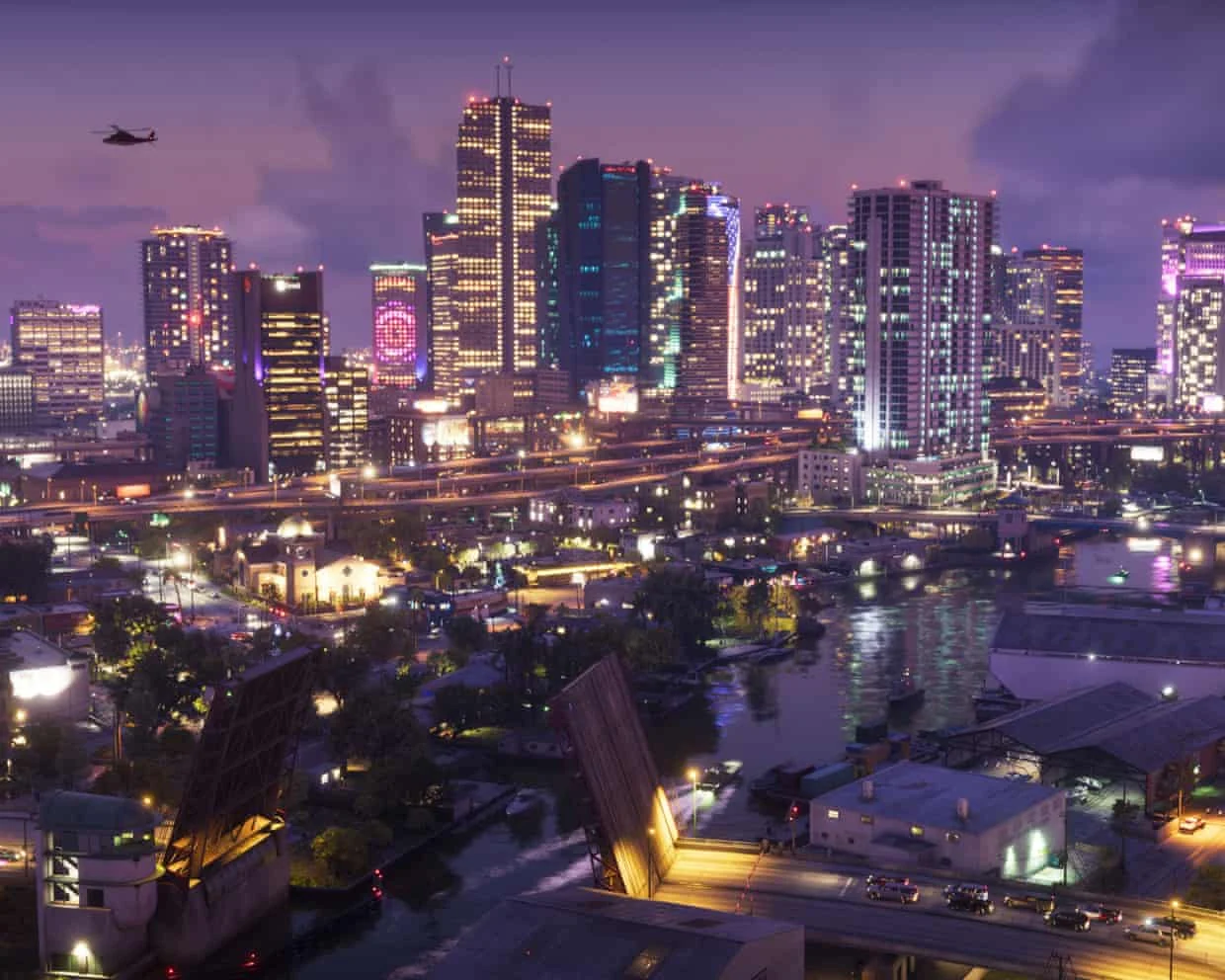
The biggest game in the world … Grand Theft Auto VI. Photograph: Rockstar Games
Developers began visiting Miami in 2015 while researching the setting for Grand Theft Auto VI. The Guardian interviewed members of Rockstar North about turning a real city and its surrounding culture into the game's fictional world. The Guardian
Key facts
The fictional state of Leonida and its Miami-inspired Vice City provide the framework for Jason and Lucia, a criminal couple on the run. The Guardian
The preview describes buildings, landscapes and neighbourhoods alongside clothes, street art, notices on cafe walls and the contents of fridges. The Guardian
Nelson demonstrated Jason eating a hot dog and, in another sequence, taking bites from a doughnut while carrying a beer. The Guardian
Vice City begins with years of observation
Rockstar's developers began exploratory trips to Miami in 2015, more than a decade before the release window discussed in the Guardian's preview of Grand Theft Auto VI. Their objective was to understand the place before deciding how its fictional counterpart should work: its geography, social contrasts, history and the everyday movement of people through it. Reporting context: The Guardian
The Guardian's account comes from a visit to Rockstar North in Edinburgh and a guided demonstration with senior developers Rob Nelson and Jennifer Kolbe. It offers a detailed look at the creative process, while remaining a preview rather than an independent assessment of the completed game.
The setting comes before the activities
The fictional state of Leonida and its Miami-inspired Vice City provide the framework for Jason and Lucia, a criminal couple on the run. Rockstar describes beginning with the setting, then working out the experiences it can offer and the story its writers want to tell within it.
That sequence helps explain why seemingly incidental spaces receive so much attention. A street must support a mission, but it also needs to make sense when the player walks through without following an objective. The world must remain coherent while attention shifts between a central narrative and unplanned exploration.
Detail extends from geography to a refrigerator
The preview describes buildings, landscapes and neighbourhoods alongside clothes, street art, notices on cafe walls and the contents of fridges. These layers give the fictional city a sense of having activities and histories that continue beyond the immediate scene.
Rockstar used comparable approaches in Grand Theft Auto V's version of California and Red Dead Redemption 2's American West. GTA VI applies that accumulated method to a different environment, with density and consistency across large and small scales forming part of the project's creative ambition. Reporting context: The Guardian
Ordinary movements receive unusual attention
Nelson demonstrated Jason eating a hot dog and, in another sequence, taking bites from a doughnut while carrying a beer. When the character ran with a six-pack, he shifted the bottles into the bend of his arm and the liquid moved inside them.
The point of these examples is not that eating animations are more important than missions. They show how the team tries to preserve a believable relationship between a character's body, the objects being carried and the speed of movement. Those transitions can make an environment feel continuous when the player changes direction or interrupts an action.
Even an action scene becomes an animation check
During a jewellery-store robbery in the demonstration, Nelson noticed that a security guard's foot placement looked wrong. The preview uses that moment to illustrate the intensity of attention applied to a scene that many players might remember mainly for its larger spectacle.
His background in character art and animation helps explain that focus. His responsibilities also include design, narrative and some casting, connecting the physical behaviour of characters with how the story is presented. The demonstration shows a senior developer responding to a specific detail, rather than supplying a measurable guarantee that every animation will be flawless.
A huge team works through specialised leadership
Almost 5,000 people contributed to the game. At the top is a comparatively small group of decision-makers, many with long histories at Rockstar, who take responsibility for areas matching their experience. Lead writer Rupert Humphries, for example, has been at the company since 2008. Reporting context: The Guardian
Nelson told the Guardian that the world is too extensive for any one person to hold every part in mind. The production method therefore depends on distributed expertise and coordination. Large staffing alone cannot explain the result; the time, funding and continuity supplied by Rockstar and parent company Take-Two also shape what can be attempted.
Fieldwork provides more than landmarks
The research visits included Miami nightlife, a South Beach police ride-along, a racetrack and bars in the Florida Keys. Artists travelled with cameras into a wide range of locations. These experiences supplied social atmosphere and movement as well as visual reference.
Kolbe connected the method with work on GTA IV's New York-inspired Liberty City, where even lifelong residents encountered unfamiliar parts of their city during research. The developers' fictional America combines places and experiences that no single resident necessarily knows in full, making it an interpretation rather than a documentary map.
What the preview establishes before release
The account shows how Rockstar approaches observation, world design and animation at exceptional scale. It also demonstrates why the company continues to find material in American settings; Nelson did not rule out other countries, but said there was still much to explore in the United States.
How the finished systems behave across a complete playthrough is a different question from what a guided visit can establish. The preview's strongest evidence concerns the deliberate craft behind particular scenes and the long research process that connects Vice City's fictional streets with real places, routines and contrasts.
Sources and editorial notes
This article compiles the linked reporting. Allegations, projections and research findings retain their original qualifications; this page does not represent independent field reporting or expert medical review.
- The Guardian (reporting)
November 17, 2026: Replaced repeated summary and FAQ templates, added source attribution and image description, and clarified the distinction between source publication and site edits. This editorial update is not an independent fact-check certification.