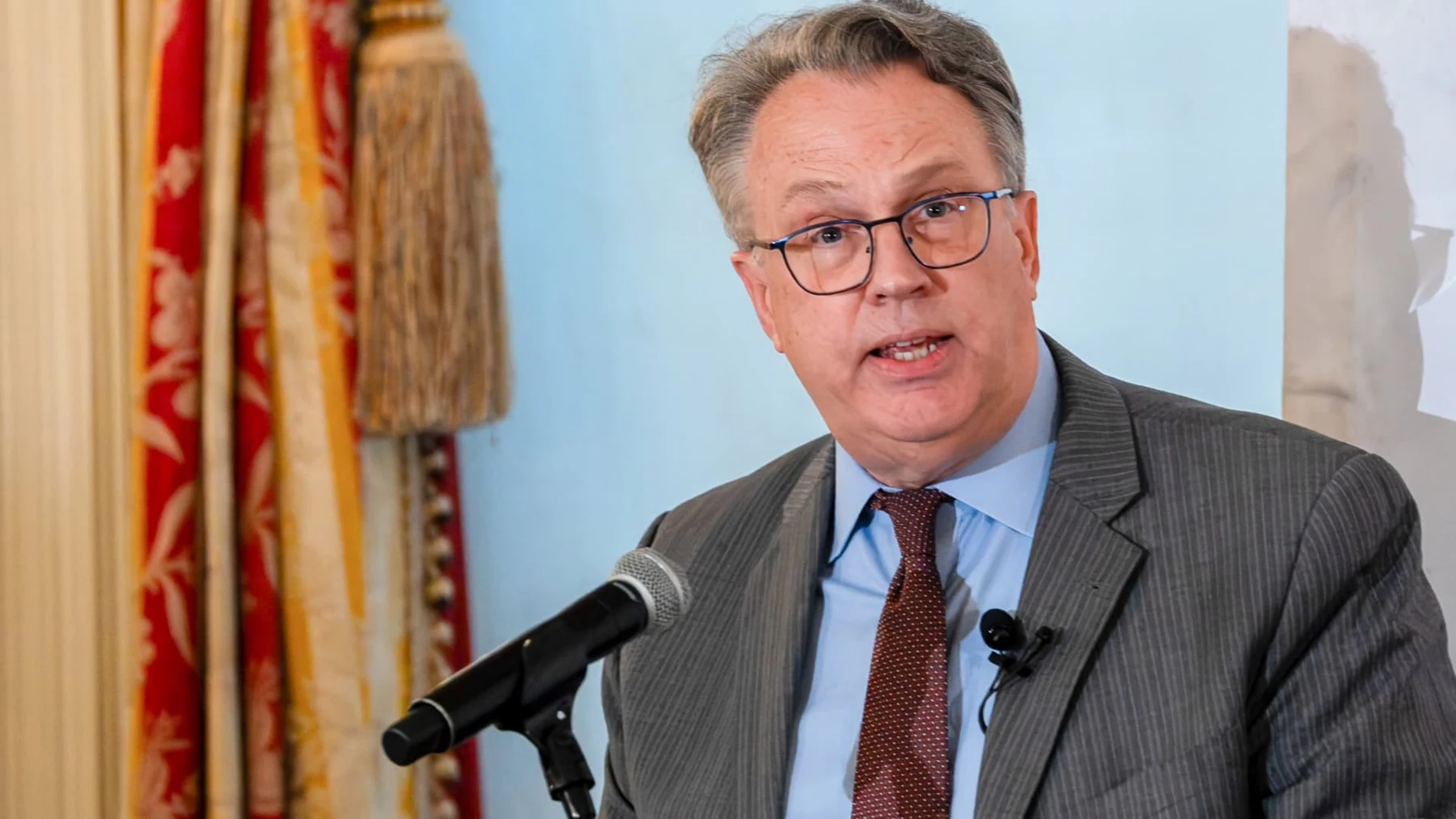
New York Fed president John Williams says inflation remains around 3.5%, above the Federal Reserve’s 2% objective, while the economy and labour market remain resilient. His 23 November speech identifies energy disruption and AI-related demand among the pressures. CNBC interprets the remarks in the debate over further rate increases. The speech is one policymaker’s assessment, not an FOMC decision or a guarantee of the next meeting’s outcome.
Key facts
Williams’s published remarks put inflation at about 3.5% against a 2% goal.
He forecasts growth of about 2.75% this year and near that pace next year.
He expects inflation just above 2% in 2027 and 2% in 2028; these are forecasts.
CNBC reports the next FOMC meeting as 8–9 December and a current 3.75%–4% target range.
What the speech says about the economy
In his published New York Fed remarks, John Williams describes an economy that has remained resilient despite large shocks. He puts growth this year at about a 2.75% annual rate and describes a broadly stable labour market, with unemployment fluctuating in the low-four-percent range. He also stresses that the speech presents his own views rather than speaking for the entire Federal Open Market Committee.
That last qualification is essential. A regional Fed president's analysis can influence expectations, but a speech is not a committee vote. It supplies an explanation of how one policymaker interprets the evidence, not an instruction that a particular rate outcome has already been adopted.
Why strong growth has not ended the inflation problem
Williams puts inflation at about 3.5%, still well above the Fed's 2% objective. He identifies several pressures: tariffs, energy and supply-chain disruption associated with geopolitical conflict, and demand for goods used in the AI buildout. His account says the effects of earlier tariffs have largely abated as an additional inflation impulse, while energy and some AI-related goods remain important.
These are different mechanisms and need different descriptions. A supply disruption can make specific goods more expensive without proving that wages are accelerating across the economy. Williams says he does not see evidence that labour-market conditions are driving inflation higher. His argument is about persistent price pressure despite broadly balanced employment conditions.
Where AI appears on both sides of the argument
AI investment contributes to business spending, productivity expectations and demand for equipment in Williams's account. At the same time, demand can outpace available supplies of semiconductors and other inputs, increasing prices in those categories. The speech therefore treats AI as an economic force with both growth and near-term price effects.
Williams also says there is little evidence that these category-specific pressures are spilling over substantially into broader, persistent inflation. That prevents a stronger claim than the source supports. “AI investment is raising some input prices” is not equivalent to “AI has permanently raised the inflation rate everywhere.” The future balance of supply and demand remains uncertain.
How the reported rate outlook differs from a decision
CNBC frames the speech within a debate over further interest-rate rises and reports market expectations for the 8–9 December meeting. It gives the current target range as 3.75%–4%. Those are different types of information: an existing policy range, a market expectation and an individual official's remarks.
CNBC notes that Williams did not explicitly endorse the expected December outcome in the speech. The primary text instead points to incoming information and the need to return inflation sustainably to target. A headline about a likely increase should therefore not be rewritten as a new rate decision already made by the committee.
What the inflation forecasts actually promise
Williams expects inflation to slow to just above 2% next year and reach 2% in 2028. He expects real growth to remain around its current pace and unemployment to edge toward 4%. These are his projections, conditional on how the economy develops. They are not promises about every household's bills or the timing of every interest-rate move.
The speech explicitly describes uncertainty around energy, supply constraints and the scale of AI investment. Those risks help explain why a forecast and a policy commitment are not interchangeable. A change in the underlying conditions could alter both the forecast and the policy assessment.
What borrowers and savers can usefully take away
The immediate signal is that inflation remains a policy concern even while the economy grows. It is not a reliable instruction that every mortgage, savings account or credit-card rate will change by the same amount on a named date. Different products have different pricing structures, contracts and reset schedules.
For the next news update, distinguish the eventual FOMC statement from speeches and market pricing beforehand. The committee's actual decision and explanation will resolve what it has chosen to do; Williams's speech explains part of the reasoning being debated. This article offers that comparison rather than a personalised investment or borrowing recommendation.
Frequently asked questions
Did Williams’s speech change the Fed interest rate?
No. His published speech presents his analysis and outlook. A speech by one official is not an FOMC decision. CNBC separately reports the existing target range and expectations for the next meeting.
Does the speech mean a December rate rise is certain?
No. CNBC reports market expectations, and also notes that Williams did not explicitly endorse a particular December outcome. Expectations and an actual committee decision are different. The next decision will depend on the committee’s assessment.
Why is inflation still a concern despite strong growth?
Williams says inflation is about 3.5%, above the 2% goal, while growth and employment remain resilient. His remarks identify energy disruption and AI-related goods demand among the pressures. Strong output does not by itself mean price stability has been restored.
Is the forecast of 2% inflation in 2028 guaranteed?
That is Williams’s forecast in the speech, not a guaranteed outcome. He describes uncertainty around energy, AI investment and supply conditions. A projection should retain those qualifications when it is quoted.
At a glance
| Issue | Verified position | Limit or next step |
|---|---|---|
| Inflation | About 3.5% in Williams’s account | Above the 2% objective |
| Growth | About 2.75% expected this year | Forecast, not a guaranteed outcome |
| AI | Strong investment and some goods-price pressure | Persistent broad spillover not established |
| Next meeting | 8–9 December reported by CNBC | No new FOMC decision in this speech |
Sources and editorial notes
This article compiles the linked reporting. Allegations, projections and research findings retain their original qualifications; this page does not represent independent field reporting or expert medical review.
- CNBC (reporting)
- Federal Reserve Bank of New York (primary)
Published on 24 November 2026 after reviewing the linked sources. This is an independently worded editorial synthesis, not an original interview or field report. Earlier articles remain dated historical coverage. November 24, 2026: Revised the FAQs to prioritise reader impact and practical questions using the cited material. The original reporting date is unchanged.