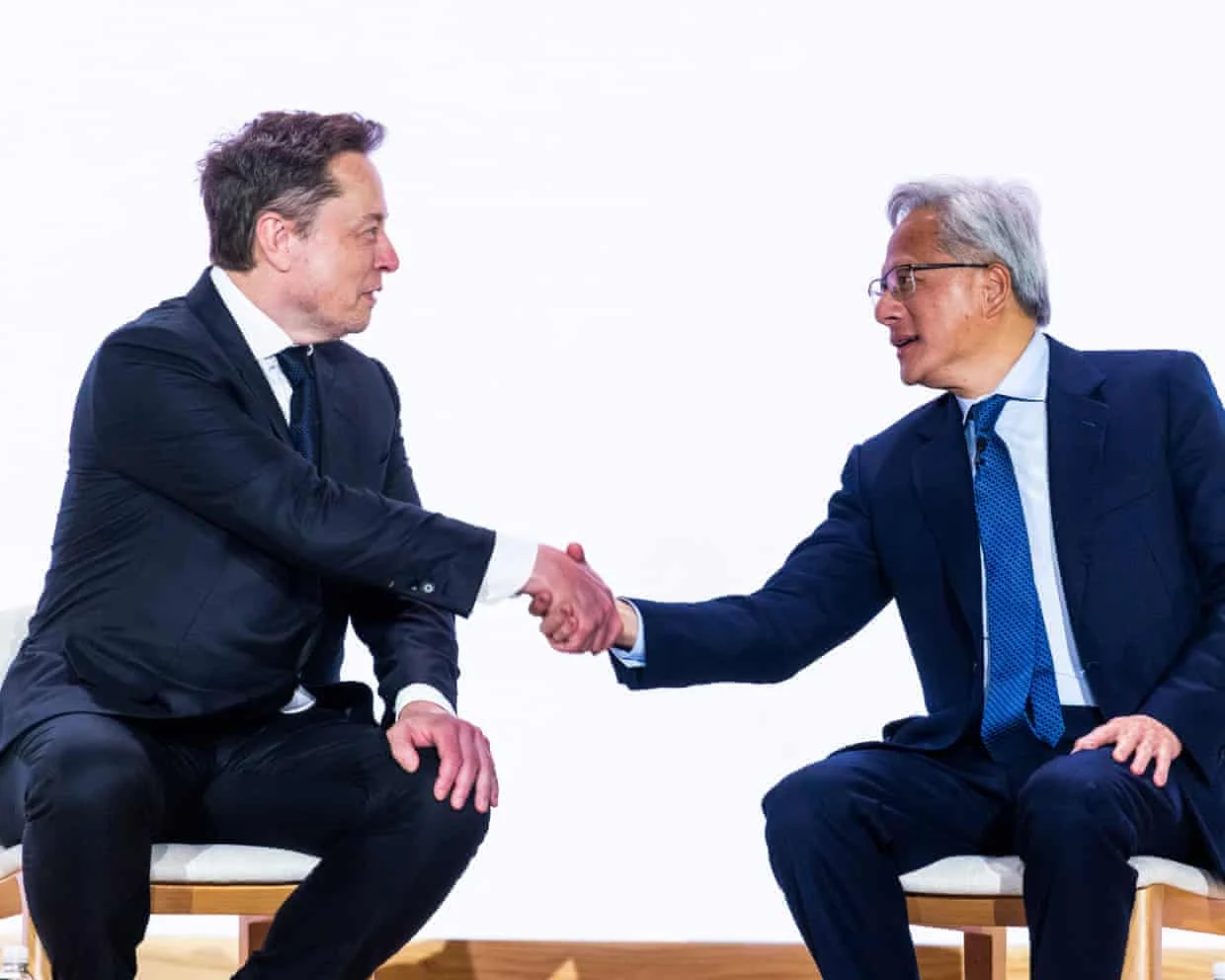
Elon Musk and Jensen Huang in September this year. Photograph: Jim Lo Scalzo/EPA
Nvidia says Jensen Huang has resigned as chief executive, president and a board member. The company appointed finance chief Colette Kress as interim CEO and praised Huang's contribution without stating a reason for his departure. NPR
Key facts
Nvidia appointed finance chief Colette Kress interim CEO after Jensen Huang’s departure from the chief executive, president and board roles. NPR
Huang acknowledged marital unfaithfulness; that admission does not establish the separately reported intelligence allegations, which China denies and NPR says it has not independently confirmed. NPR
Nvidia hired Wachtell, Lipton, Rosen & Katz to investigate; the existence of an inquiry does not establish its eventual findings. NPR
Nvidia enters an unexpected leadership transition
Jensen Huang has resigned as Nvidia's chief executive, president and board member, ending his leadership of the company he co-founded in 1993. The board appointed chief financial officer Colette Kress as interim chief executive while it searches for a permanent successor. NPR reports that the announcement followed revelations about extramarital relationships and allegations involving a woman suspected by US intelligence officials of working for China. Nvidia's resignation statement praised Huang's contribution but did not specify a reason for his departure.
Related coverage: Who is Nvidia's interim CEO Colette Kress - and who could take over permanently?.
An admission and further reported relationships
Huang acknowledged earlier in the week that he had been unfaithful to his wife and apologised to his family. That admission did not itself establish the intelligence allegations. The Guardian reports that subsequent coverage identified another alleged relationship with Nvidia healthcare executive Kimberly Powell, followed by Reuters reporting a third alleged affair involving an unnamed employee. These later accounts intensified questions about workplace governance and the board's oversight of a chief executive with exceptional influence over the company.
The intelligence allegations remain distinct
The separate national security concern involves Alice Huang, a Chinese businesswoman associated with Singapore-based data-centre company Megaspeed, who is not related to Jensen Huang. Reporting describes US officials' suspicion that she was recruited by Chinese intelligence. China denies the allegation, and NPR explicitly says it has not independently confirmed it. The available reports do not establish that Nvidia information was compromised or identify intelligence supposedly passed to Beijing. A reported relationship, suspicion about a person's role and proof of an information breach are different propositions.
The board's investigation and succession search
Nvidia hired Wachtell, Lipton, Rosen & Katz to conduct an independent investigation before Huang's departure. The board initially kept him in charge while that work continued. Its later announcement installed Kress temporarily and opened consideration of internal and external candidates. The Guardian also reports that Harvey Jones became the company's first chair. Speculation about possible successors includes executives from Nvidia and other technology businesses, but none of those suggestions constitutes an announced permanent appointment or a completed recruitment process.
Why replacing the founder is unusually difficult
Huang helped move Nvidia from graphics processors associated with gaming into the infrastructure of modern AI. Its chips train and operate systems built by many of the world's largest technology companies. His management style concentrated decisions around him, with roughly 60 direct reports according to the Guardian. That makes succession more than a change in public spokesperson: the company must redistribute technical judgement, customer relationships and day-to-day authority previously tied closely to its founder. Kress brings familiarity with the business, while the board still has to define its longer-term leadership structure. Reporting context: NPR
Investors reassess a central AI company
Market reports captured different points in a volatile session. The Guardian says Nvidia shares initially dropped around 13% after the departure announcement before closing Thursday down 4.3%, removing more than $180 billion in value that day. NPR's contemporaneous account placed the decline since the preceding Friday at roughly 11%. Those measurements use different intervals. The response matters beyond Nvidia shareholders because the company has become a significant component of investment portfolios and a major supplier to businesses spending heavily on AI infrastructure. Reporting context: NPR
Earnings provide the next concrete test
The company's next quarterly results, scheduled for Tuesday, will give Kress an opportunity to explain operating performance and address confidence in Nvidia's direction. The unresolved questions include the investigation's findings, the permanent appointment and how the organisation functions without Huang's direct leadership. The evidence available so far supports reporting a major governance crisis and leadership change. It does not support treating the espionage allegations as proven or assuming that a management upheaval has already translated into a demonstrated failure of Nvidia's products or customer demand.
Export controls explain the strategic sensitivity
The BBC places the allegations in the context of US restrictions introduced from 2022 to limit China's access to advanced chips. Those controls reflect Washington's concern about military and surveillance applications as well as commercial competition. Huang had sought ways to restore access to the Chinese market within US rules. Megaspeed has faced scrutiny in Singapore over alleged circumvention of chip-export restrictions; Nvidia has previously said it investigated the business and found no cause for concern. Neither that separate regulatory scrutiny nor Huang's lobbying establishes that he knowingly assisted an intelligence operation.
From gaming hardware to AI infrastructure
The company was founded by Huang, Chris Malachowsky and Curtis Priem. Its early identity centred on graphics processing, especially for games, before investment in broader computing made its hardware important to the AI boom. That history helps explain the scale of the reaction: the departing executive is closely associated with strategic bets made long before today's demand emerged. Nvidia's customers include businesses building models and operating large data centres, so continuity involves product development, manufacturing partners and customer investment plans as well as leadership reputation. Those established operations give the board a substantial business to oversee while it investigates the allegations and chooses its next leader.
Questions readers ask
Did Nvidia’s resignation announcement establish the intelligence allegations?
No. The company announced the leadership change without publishing findings establishing those allegations. NPR says it has not independently confirmed the intelligence claim; China denies it. NPR
Sources and editorial notes
This article compiles the linked reporting. Allegations, projections and research findings retain their original qualifications; this page does not represent independent field reporting or expert medical review.
- NPR (reporting)
- The Guardian (reporting)
- The BBC (reporting)
November 17, 2026: Replaced repeated summary and FAQ templates, added source attribution and image description, and clarified the distinction between source publication and site edits. This editorial update is not an independent fact-check certification.