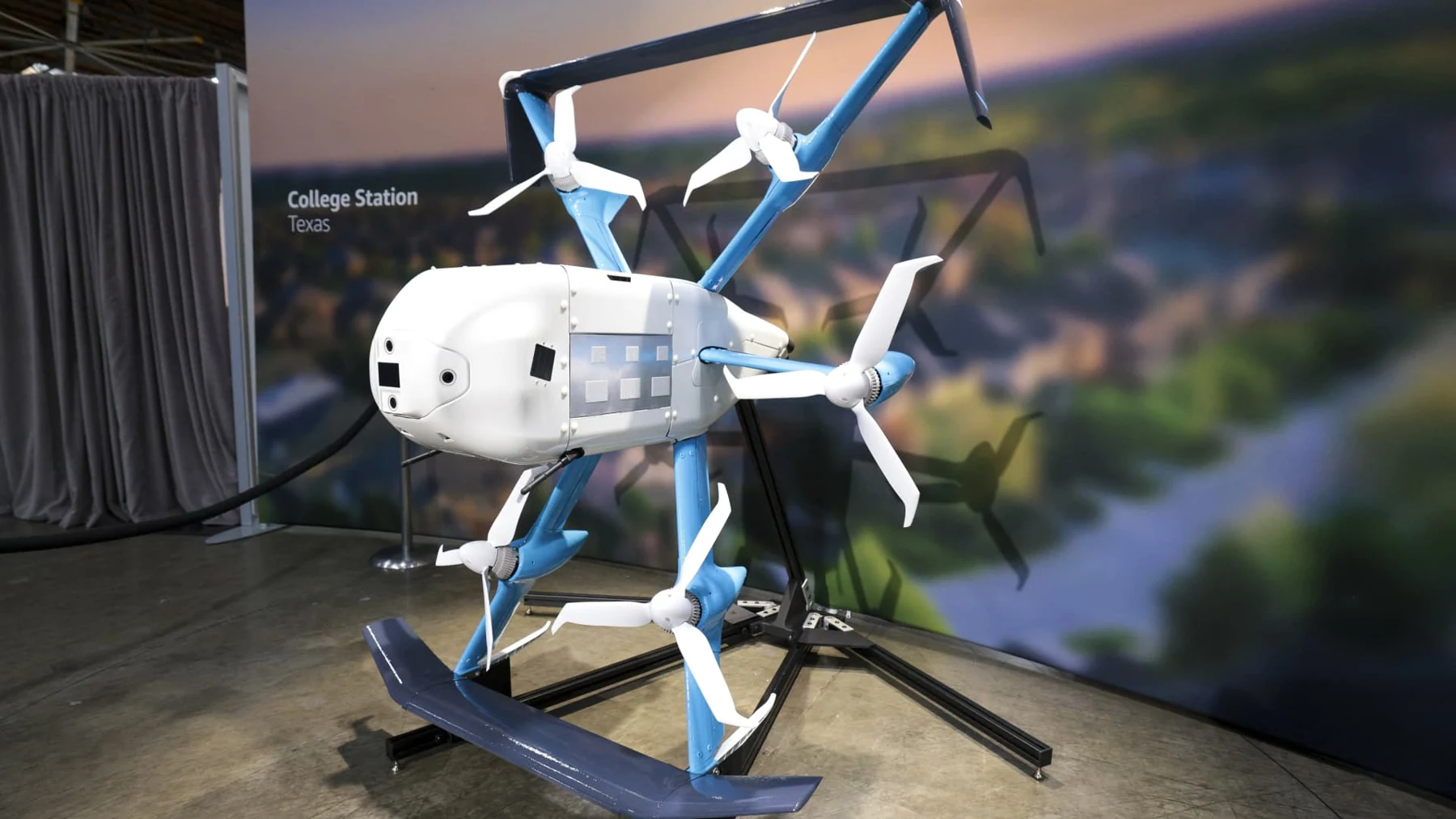
The FAA is investigating an Amazon delivery-drone incident in Huntington Woods, Michigan, CNBC reports. Local station WXYZ describes a drone striking an overhead line after dropping off shampoo and then coming down on a garage. Amazon says no one was injured. The accounts establish an incident and an investigation, but they do not yet establish a final technical cause, a fleet-wide failure rate or an announced nationwide suspension.
Key facts
The incident occurred on Friday, 20 November, after a delivery in Huntington Woods.
CNBC reports an FAA inquiry; the NTSB was still deciding whether to open one.
Amazon says no injuries occurred and the drone was removed.
WXYZ’s eyewitness account describes an overhead cable encounter during departure.
What happened after the package was delivered?
Local station WXYZ Detroit reports that an Amazon drone arrived at a home in Huntington Woods on Friday, 20 November, for a shampoo delivery. A resident said the package had been dropped off before the drone rose into an overhead line, lost a propeller and ended up against a neighbouring garage and electrical cable. Amazon's team later removed the aircraft with help from the utility.
The sequence is important because a successful package drop does not describe the whole flight. The reported problem occurred during departure. Delivery performance therefore needs to include approach, release and return to flight, rather than treating the moment a package reaches the ground as the only relevant safety measure.
What the FAA and other agencies have said
CNBC reports that the FAA is investigating. It quotes a preliminary report describing a strike involving a fibre cable, a residential garage and entanglement in power lines during takeoff. CNBC also reports that the National Transportation Safety Board was gathering information but had not yet decided whether to open a separate investigation.
An inquiry and a preliminary incident description are not a completed determination of cause. The agency positions should also remain distinct: the FAA's confirmed investigation does not mean the NTSB has announced an identical action. Later findings may add detail that neither a witness nor a company spokesperson can establish at this stage.
What Amazon and the residents agree on
Amazon told CNBC and WXYZ that no one was injured, the drone had been removed and the company was in contact with the resident. WXYZ's interviews describe visible damage to the garage and residents' questions about obstacle detection. A resident also said Amazon was responsive about dealing with damage.
These accounts overlap on the absence of reported injuries and the removal of the aircraft, while serving different purposes. The company's statement gives its immediate response; the interviews describe what people nearby saw and experienced. Neither should be quietly converted into a final engineering explanation of why the aircraft encountered the cable.
Why overhead wires are the central question here
The witness account and the preliminary report both make the overhead infrastructure relevant. What is still missing is a published technical explanation of how the aircraft perceived the environment, what route it planned and why the departure ended in contact. The reporting does not establish whether a particular sensor, software decision or other factor was responsible.
That evidential gap matters when drawing lessons. A reader can reasonably ask how the system handles thin obstacles and unexpected conditions without asserting a specific defect before the investigation reports. The same restraint applies to claims about weather, human intervention or maintenance, none of which is established as the cause in these sources.
What one incident cannot tell us about the entire service
Amazon describes incidents as extremely rare, while CNBC puts the crash alongside earlier reported investigations in Texas and Arizona. WXYZ also reports disagreement about whether there had been another Michigan crash. Those statements do not provide a complete, consistently defined incident dataset for the fleet.
A meaningful safety-rate comparison would require a verified denominator, a definition of reportable events and comparable operating conditions. Counting a few headlines or repeating an operator's general reassurance is not enough to calculate a fleet-wide failure rate. The current case establishes a real local incident without settling that broader statistical question.
What would answer the remaining safety questions?
A later agency finding could distinguish the recorded sequence from the cause, identify corrective action and clarify whether the case has implications beyond one address. Those would be substantive developments. The sources reviewed here do not announce a nationwide grounding of Amazon's delivery drones or a conclusion that every similar flight is unsafe.
For people near the incident, damage repair and clear communication are separate practical issues from the investigation's engineering work. The local account makes those consequences visible. Keeping the local impact, the company response and the regulator's eventual findings distinct gives a more useful picture than either an unqualified reassurance or a claim that the entire programme has already been halted.
Frequently asked questions
Was anyone hurt or any property damaged in the Michigan crash?
Amazon says there were no injuries, as reported by CNBC and WXYZ. The local report describes damage to a garage. The absence of reported injuries does not remove the need to determine why the incident occurred.
Has the crash stopped Amazon drone deliveries across the US?
No nationwide suspension is established by these sources. The local report describes one address being placed on a no-drone list as a precaution. That should not be restated as a regulator grounding the entire service.
Do investigators know what caused the crash?
Not in the reports reviewed here. CNBC confirms an FAA investigation and a preliminary incident account. That is not a published finding identifying a particular sensor, software or other technical fault.
Did the drone crash before or after dropping off the package?
The WXYZ account says the package had been dropped off and the incident occurred as the drone departed. CNBC quotes a preliminary FAA description referring to takeoff. A completed drop and a safe overall flight are different measures.
At a glance
| Issue | Verified position | Limit or next step |
|---|---|---|
| Event | Cable and garage contact after delivery reported | Final technical cause not published |
| Injuries | None reported by Amazon | Property damage described locally |
| FAA | Investigation confirmed to CNBC | Preliminary account is not a final finding |
| NTSB | Gathering information | Separate inquiry not yet confirmed in report |
Sources and editorial notes
This article compiles the linked reporting. Allegations, projections and research findings retain their original qualifications; this page does not represent independent field reporting or expert medical review.
- CNBC (reporting)
- WXYZ Detroit (reporting)
Published on 24 November 2026 after reviewing the linked sources. This is an independently worded editorial synthesis, not an original interview or field report. Earlier articles remain dated historical coverage. November 24, 2026: Revised the FAQs to prioritise reader impact and practical questions using the cited material. The original reporting date is unchanged.